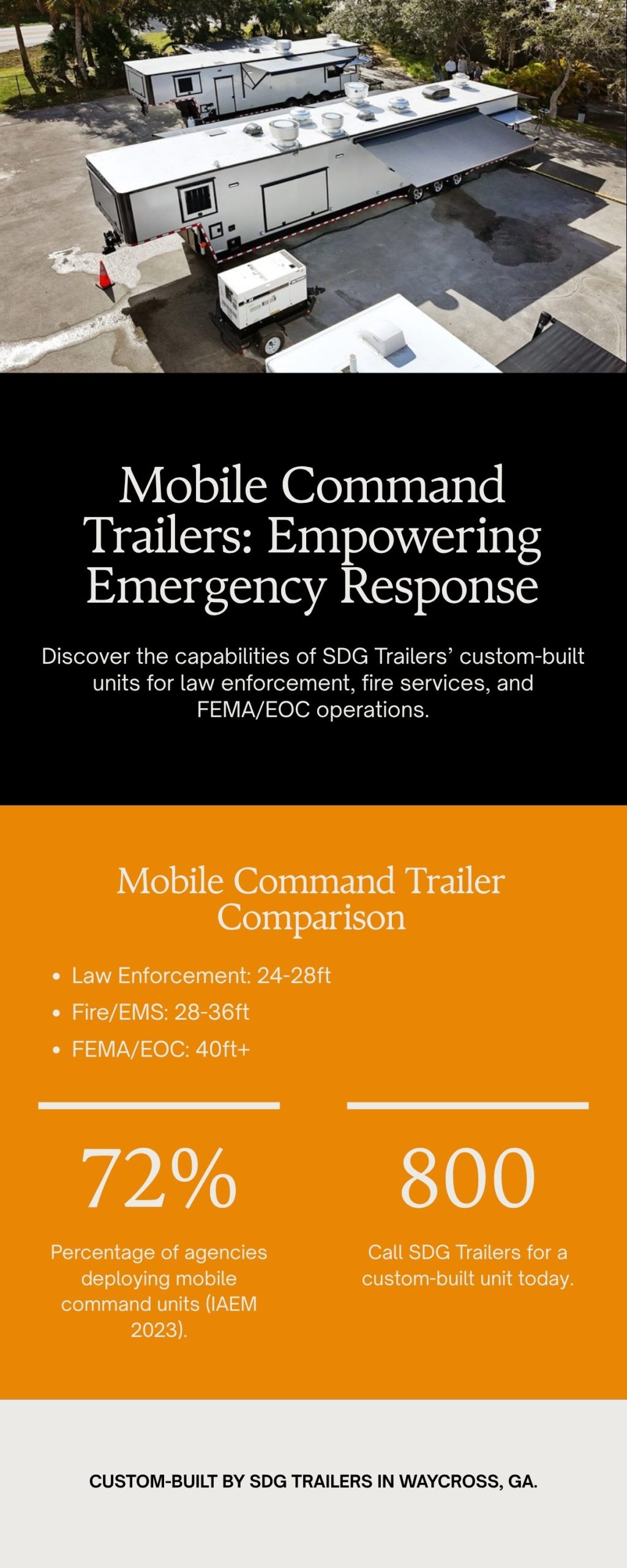
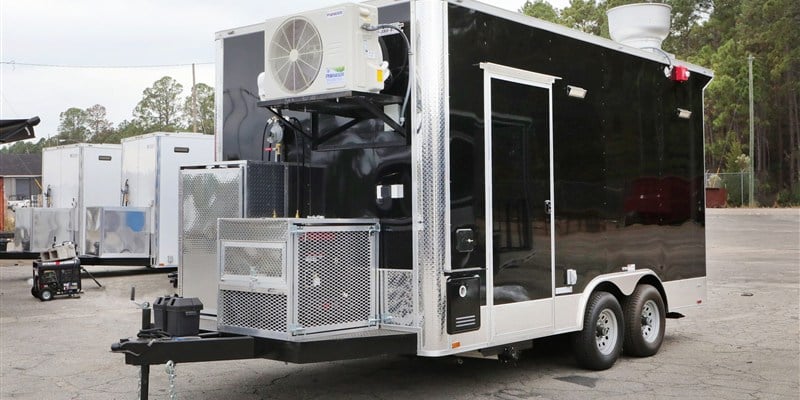
A mobile command trailer is a self-contained, road-deployable command post that gives incident commanders a hardened, climate-controlled workspace anywhere in the field. It arrives, sets up, and functions as a fully operational Emergency Operations Center within hours of an incident. No renting conference rooms. No borrowing county facilities. No working out of the back of a vehicle.
This guide covers everything buyers need to know: the organizations that deploy mobile command trailers, key specifications, how SDG Trailers builds them, realistic pricing, and how to start the procurement process. If you’re evaluating a mobile command center for a sheriff’s department, county emergency management office, federal agency, or NGO, this is your complete reference.
Key Takeaways
- A mobile command trailer provides a hardened, climate-controlled field EOC deployable anywhere within hours
- Typical uses: multi-agency law enforcement operations, disaster incident command, search and rescue coordination, utility emergency response
- Standard specs: 28-40 ft, GVWR 14,000-26,000 lbs, custom electronics and workstations, climate control, generator hookups
- Real SDG clients include the Riverside Sheriffs’ Association and government agencies requiring rapid-deploy field command capability
- Pricing ranges from $80,000 to $250,000+ depending on configuration, electronics, and build complexity
- SDG builds all mobile command trailers factory-direct in Waycross, GA; 4-12 week lead times; ships all 50 states
What Does a Mobile Command Trailer Do?
A mobile command trailer transforms any field location into a functional incident command post. It’s designed for one purpose: giving incident commanders everything they need to run a complex, multi-agency operation from a position that’s physically close to the action.
That means climate-controlled workspace regardless of outdoor conditions. It means secure communications infrastructure. It means workstations, display screens, briefing space, and power conditioning for sensitive electronics – all road-deployable and operational within the time it takes to level the trailer and run the generator.
The alternative is improvising. Tents collapse in weather. Parking lot briefings don’t scale to 50 personnel. Borrowed county buildings aren’t always available, aren’t positioned where you need them, and don’t have the communications infrastructure required. A mobile command trailer eliminates all of that. It’s purpose-built for field command, and it shows up exactly where you need it.
FEMA’s National Response Framework recognizes Incident Command as one of the foundational functions of emergency response – and specifically identifies mobile command capability as essential for large-scale operations that require multi-agency coordination (FEMA National Response Framework, 2023). In practice, that means a mobile command trailer is a core infrastructure investment for any agency that handles complex incidents.
Who Uses Mobile Command Trailers?
The buyer landscape for mobile command trailers spans law enforcement, emergency management, military contractors, and utility companies. What they share: a requirement for field-deployable command capability that doesn’t depend on fixed infrastructure.
Sheriff departments and law enforcement agencies. This is the largest single category of mobile command trailer buyers. Sheriffs need field command capability for SWAT operations, large-scale search and rescue, mass casualty incidents, and extended tactical operations. The Riverside Sheriffs’ Association is one of SDG’s mobile command clients – a jurisdiction that deploys command capability supporting multi-agency operations across a large service area.
County and state emergency management offices. Every county-level EMA needs a deployable command capability for declared disasters: hurricanes, floods, wildfires, industrial incidents. Mobile command trailers serve as forward EOCs when the fixed EOC is in the affected zone, too far from operations, or operating beyond capacity.
FEMA and federal agencies. Federal disaster response coordinates through Unified Command structures that often require multiple field command posts operating simultaneously. FEMA issued 102 major disaster declarations in fiscal year 2024 (FEMA Disaster Declarations Summary, 2024) – each one a potential deployment for mobile command assets.
Military and federal contractors. DoD contractors, homeland security contractors, and federal law enforcement agencies all maintain mobile command assets for rapid deployment. These builds often require specific GVWR certifications, secure communications infrastructure, and mil-spec power conditioning.
Utilities and energy companies. Major outages – hurricanes, ice storms, wildfires – require coordinated field operations over days or weeks. Utility companies deploy mobile command trailers as coordination hubs for line restoration crews spread across large geographic areas.
Fire departments and EMS agencies. Mass casualty events, wildland fire operations, and Hazmat incidents all benefit from field command capability. Fire departments use mobile command trailers as unified command posts for multi-agency response.
Mobile Command Trailer Specs: What to Look For
Getting the specs right starts with your operational requirements: how many personnel need to work simultaneously, what communications and AV equipment must be accommodated, and what tow vehicle you have or can acquire.
GVWR and Trailer Length
GVWR determines your legal towing requirements and the practical size of the command space available. Here’s how it breaks down:
- Compact (20-28 ft, up to 14k lbs GVWR): Suited for single-agency forward command posts. Fits 2-6 workstations. Can be towed with a 3/4-ton or 1-ton pickup. Fast to deploy, easy to position in tight areas.
- Standard (28-36 ft, 14k-20k lbs GVWR): The most common configuration for county EMAs and sheriff departments. 6-12 workstations, full AV and communications rack, briefing space. Requires a medium-duty truck or heavy-duty pickup.
- Heavy-duty (36-40 ft, 20k-26k lbs GVWR): Built for multi-agency Unified Command operations with 12-20+ simultaneous workstations. Full climate control, exterior cable pass-throughs for multiple antenna and fiber connections, onboard generator provision.
Interior Layout
Interior layout is fully custom. There’s no standard floor plan because there’s no standard mission. The components SDG builds into mobile command trailers:
Workstations. Wall-mounted or free-standing stations with power, data, and communications connections at each position. Monitor arm mounts for dual or triple screen setups.
Display screens. Large-format screens (55-86 inch) on adjustable mounts for situation displays, map overlays, video feeds, and incident tracking.
Communications equipment racks. 19-inch equipment racks, often in a locked enclosure, for radios, repeaters, satellite communication equipment, and network switching.
Power conditioning. Sensitive electronics require stable, clean power. SDG installs UPS (Uninterruptible Power Supply) systems and power conditioning that isolate electronics from generator fluctuation.
Climate control. Diesel-fired or electric HVAC, sized for continuous operation with electronics heat load factored in. Field command operations can run 24 hours; the HVAC needs to keep pace.
Exterior cable pass-throughs. Weatherproof exterior penetrations for antenna cables, fiber, shore power, and camera feeds. Layout and count are spec’d to your communications requirements.
Conference and briefing space. Fold-out tables, whiteboard surfaces, and seating configurations for in-trailer briefings. Some builds include a separate briefing bay partitioned from the workstation area.
Generator and Power
Off-grid operation requires a generator matched to your total electrical load. A standard mobile command configuration runs 15-25 kW. Heavy-duty builds with full electronics, HVAC, and perimeter lighting may need 30-40 kW. SDG engineers the power system to your spec – either onboard generator mounting or provisions for external generator hookup.
Shore power connections are standard for deployments at fixed facilities (staging areas, airports, fairgrounds) where grid power is available.
| Class | Length | GVWR | Workstations | Typical Use |
|---|---|---|---|---|
| Compact | 20-28 ft | Up to 14k lbs | 2-6 | Forward command, single-agency |
| Standard | 28-36 ft | 14k-20k lbs | 6-12 | County EMA, sheriff, mid-scale response |
| Heavy-Duty | 36-40 ft | 20k-26k lbs | 12-20+ | Multi-agency Unified Command, federal |
SDG Trailers: Mobile Command Builds
SDG Trailers has been building custom trailers in Waycross, GA since 2001. Mobile command center work spans law enforcement, emergency management, and government contractors who require field-deployable command capability that performs under real operational conditions.
Riverside Sheriffs’ Association
The Riverside Sheriffs’ Association is one of SDG’s mobile command center clients. Their requirement: a field-deployable command unit that supports multi-agency operations across a large service area, deployable on short notice and fully self-sufficient for extended operations.
A sheriff’s department mobile command trailer needs to handle both planned large-scale events (security operations for public gatherings) and unplanned incidents (search and rescue operations, major crime scenes, mass casualty events). The build has to be versatile enough for both mission profiles without compromise on either.
Law Enforcement and Emergency Management
SDG builds mobile command trailers for a range of law enforcement and emergency management clients. The common thread: organizations that can’t predict exactly when they’ll need field command capability, but know that when they do, it has to work the first time.
That means rugged construction, reliable climate control, and electronics infrastructure that survives the road trip to the deployment site. A mobile command trailer that arrives at a disaster scene with failed equipment is worse than useless – it’s a distraction at the worst possible time.
The same engineering discipline that goes into SDG’s mass feeding builds – the Patriot Response Group (PRG) kitchen fleet that serves 5,000+ meals per day in active disaster zones – applies to mobile command construction. Field-ready uptime isn’t a feature. It’s the baseline.
How Much Does a Mobile Command Trailer Cost?
Mobile command trailers range from approximately $80,000 for a compact single-agency forward command unit to $250,000 or more for a heavy-duty multi-agency build with full electronics infrastructure and advanced communications systems.
Cost is driven primarily by:
Trailer size and GVWR. Larger trailers require heavier axle configurations and more structural material. A 40-ft build costs significantly more than a 28-ft build before any equipment is factored in.
Electronics and AV systems. Display screens, communications racks, workstations, UPS systems, and network infrastructure represent a substantial portion of total cost in mobile command builds. A basic workstation setup runs far less than a fully integrated multi-screen situation display with redundant communications.
Climate control specification. Continuous operation with high electronics heat load requires commercial-grade HVAC systems. Under-spec’d climate control is a field failure waiting to happen.
Custom fabrication. Conference partitions, custom millwork for equipment racks, exterior cable management, and specialized mounting systems add cost relative to a basic open-floor build.
Realistic ranges by class:
- Compact (20-28 ft): $80,000-$130,000. Basic forward command capability with workstations, climate control, and communications provision.
- Standard (28-36 ft): $120,000-$180,000. Full county or department command capability with AV, multi-workstation layout, and exterior communications infrastructure.
- Heavy-duty (36-40 ft): $180,000-$250,000+. Multi-agency Unified Command configuration with full electronics, advanced communications, and extended operational autonomy.
SDG provides factory-direct quotes with full itemized specs. No dealer markup. Financing is available for qualified buyers including government agencies and nonprofit organizations – learn more on the financing page.
How to Buy a Mobile Command Trailer from SDG
The procurement process follows four steps:
Step 1: Define your mission profile. What incidents will this trailer respond to? How many personnel need to work simultaneously? What communications systems must be accommodated? What’s your tow vehicle? Answering these questions before the first call makes the spec conversation significantly more productive.
Step 2: Build your spec. Translate mission profile into specifications: trailer length, GVWR, workstation count, display configuration, communications rack requirements, generator provision, and HVAC spec. SDG’s team works through this with every buyer. It’s a conversation, not a catalog lookup.
Step 3: Request a factory-direct quote. SDG quotes everything in-house – no dealer, no markup. The quote covers materials, fabrication, equipment installation, and delivery. Complex builds may include a preliminary design phase before final pricing.
Step 4: Confirm timeline and order. Build times run 4-12 weeks depending on complexity. Compact builds can deliver in 4-6 weeks. Heavy-duty multi-agency builds typically run 8-12 weeks. SDG ships to all 50 states; international delivery is available.
Request a quote from SDG Trailers to start the conversation about your mobile command center requirements.
Frequently Asked Questions About Mobile Command Trailers
What’s the difference between a mobile command trailer and a standard cargo trailer conversion?
Engineering and purpose-built design. Cargo trailer conversions start with a structure built for freight and adapt it – usually with compromises on insulation, power, structural reinforcement, and electronics infrastructure. A purpose-built mobile command trailer from SDG is engineered from the frame up for field command operations: heavier axle ratings for electronics weight, precision climate control factoring in electronics heat load, and structural reinforcement for mounting systems. The difference is visible in operational conditions.
How long does it take to set up a mobile command trailer at a deployment site?
A well-designed mobile command trailer can be operational within 1-2 hours of arrival: level the trailer, run the generator, deploy slide-outs if equipped, power up electronics, and establish communications links. Some configurations deploy faster. The setup time is engineered into the design – equipment mounts, cable management, and power distribution should all be designed for rapid deployment, not optimized for the showroom.
Can mobile command trailers operate in extreme weather?
Yes, with proper specification. Climate control must be sized for both summer heat (ambient plus electronics load) and winter cold. SDG engineers HVAC systems for continuous operation across the temperature range your deployment zone requires. Exterior penetrations are weatherproofed. The trailer structure itself is built to withstand road travel to a disaster site, which typically means it can handle the weather at the site as well.
Do SDG’s mobile command trailers meet NIMS standards?
SDG builds to NIMS (National Incident Management System) and ICS (Incident Command System) standards. Specific compliance requirements for federal contracts should be discussed with SDG’s team during the spec phase, as requirements vary by agency and contract vehicle.
Can I add a mobile command trailer to an existing fleet or replace an older unit?
Yes. SDG builds replacement and fleet-addition units for agencies upgrading older command trailers. The spec process is the same whether it’s your first unit or your fifth. If you have an existing unit’s floor plan and want to replicate or improve on it, SDG’s team can work from that baseline.
Get a Quote from SDG Trailers
SDG Trailers has been building custom trailers in Waycross, GA since 2001. The Riverside Sheriffs’ Association and other law enforcement and emergency management clients across the country rely on SDG-built mobile command trailers because purpose-built outperforms off-the-shelf every time.
If you’re evaluating a mobile command center, whether it’s your agency’s first or a replacement for an aging unit, the conversation starts with your mission profile. SDG’s team works through the spec with you before a single dollar changes hands.
Call (800) 380-9743. Phones are answered Monday through Friday, 8 AM to 7 PM.
Email sdgtrailers@gmail.com with your project requirements for a written quote.
Visit or ship to: 2255 Industrial Blvd, Waycross, GA 31503
SDG ships all 50 states and internationally. Build times: 4-12 weeks. Financing available for qualified buyers.
Request a Quote | See All Disaster Relief Trailers | Financing
Related guides: Emergency Response Trailer Guide | Disaster Relief Trailers: Complete Buyer’s Guide | Disaster Relief Mobile Kitchen Guide
Author: SDG Trailers Team | Southern Dimensions Group | Waycross, GA 31503 | (800) 380-9743