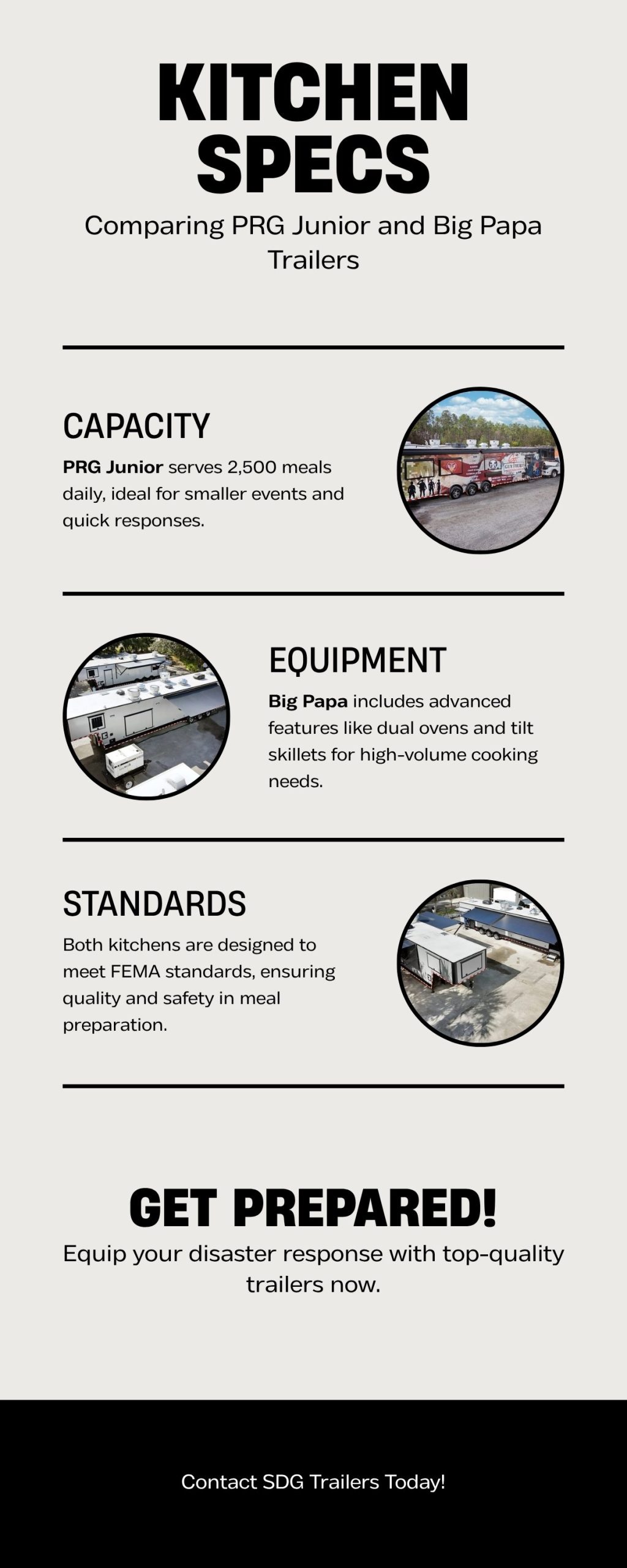
A disaster relief mobile kitchen trailer is a fully self-contained, towable commercial kitchen engineered to produce hundreds or thousands of hot meals per day without grid power, municipal water, or permanent infrastructure. These units deploy to hurricanes, wildfires, floods, and large-scale emergency events where fixed kitchens don’t exist.
SDG Trailers has been building custom trailers in Waycross, Georgia since 2001. In 2024, SDG completed what may be the most capable disaster-relief kitchen fleet ever built for a private operator – the “Junior” (40ft) and “Big Papa” (52ft gooseneck) for Patriot Response Group (PRG). Together, those two trailers serve more than 5,000 meals per day. This post breaks down exactly how they’re built, what equipment makes mass feeding possible, and how to spec the right trailer for your mission. For a broader overview of all trailer types SDG builds for disaster response, see our complete disaster relief trailer guide.
Key Takeaways
- A disaster relief mobile kitchen trailer is a self-contained towable commercial kitchen built for off-grid, high-volume food production at emergency sites.
- Daily meal capacity ranges from 200 meals (compact 16-24ft units) to 5,000+ meals (heavy gooseneck builds like the 52ft PRG Big Papa).
- Core equipment includes high-BTU commercial ranges, double-stack or 20-rack ovens, rotisserie units, tilt skillets, and self-contained water systems.
- SDG Trailers builds custom disaster kitchen trailers in 4-12 weeks, shipping all 50 states and internationally.
- SDG builds the most capable custom disaster relief kitchen trailers in the United States – documented by the PRG fleet serving 5,000+ meals per day. (SDG Trailers, first-party, 2024)
Table of Contents
- What Is a Disaster Relief Mobile Kitchen Trailer?
- How Many Meals Can a Mobile Kitchen Trailer Serve?
- What Equipment Does a Disaster Relief Kitchen Trailer Need?
- The PRG Fleet: SDG’s Most Advanced Build
- Guy Fieri Foundation Deployment
- Off-Grid Capability
- How to Spec a Disaster Relief Kitchen Trailer
- Frequently Asked Questions
What Is a Disaster Relief Mobile Kitchen Trailer?
A disaster relief mobile kitchen trailer is a purpose-built commercial kitchen on wheels – not a retrofitted concession trailer. According to FEMA’s Mass Care guidance, large-scale disaster feeding operations must provide a minimum of 2,100 calories per person per day (FEMA, Mass Care/Emergency Assistance Guidelines, 2021), which demands the kind of throughput only heavy-duty commercial equipment can deliver.
How it differs from a standard food concession trailer:
A concession trailer is built for events. It serves a menu. A disaster relief kitchen is built for volume, durability, and independence. The differences from a standard retail food trailer are structural, not cosmetic:
- Self-contained power: generator hookup or built-in generator compartment, often 30-100kW capacity
- Independent water system: large freshwater tanks (100-500+ gallons) plus greywater containment and custom floor drains
- Heavy-duty commercial equipment: full 60-inch ranges, multi-rack ovens, 40-gallon tilt skillets, and rotisserie units rated for continuous daily operation
- Off-grid deployment: no shore power, no municipal water, no building required
- Structural capacity: heavy axle ratings for long-haul transport and rough terrain access
SDG’s food and concession trailers share the same factory-direct build process but are designed for commercial event use – the disaster relief versions add the off-grid systems that make field deployment possible.
How Many Meals Can a Mobile Kitchen Trailer Serve Per Day?
Capacity is a function of trailer length, equipment configuration, and crew size – not just trailer size alone. That said, length is the best quick proxy because more length means more cooking stations. The USDA recommends that mass feeding sites in disaster zones be capable of serving meals to entire affected populations within a defined time window (USDA Food and Nutrition Service, Disaster Nutrition Assistance, 2022), which drives the need for high-throughput, scalable kitchen rigs.
What Equipment Does a Disaster Relief Kitchen Trailer Need?
The equipment list is the heart of the build. Every item below connects to a real-world throughput problem at scale. NSF/ANSI Standard 4 governs commercial cooking equipment in mobile environments, requiring that all food-contact surfaces and cooking equipment meet sanitation standards for commercial use (NSF International, NSF/ANSI 4: Commercial Cooking Equipment, 2023). Spec these right and the trailer runs 16-hour days for weeks without failure.
Commercial Range (60-Inch or Larger)
A 60-inch, 6-burner commercial range gives you the BTU output to boil 60-quart stock pots, brown large protein batches, and maintain continuous heat across multiple burners simultaneously. For disaster feeding, you need a range that won’t throttle output when every burner is running full tilt.
Commercial Ovens (Double-Stack or 20-Rack)
Double-stack convection ovens handle bread, casseroles, and roasted proteins at volume. A 20-rack commercial oven – like those in the PRG Big Papa – can hold an entire commercial kitchen’s worth of sheet pans. When you’re feeding thousands, the oven is your multiplier.
Commercial Fryers (40-lb Capacity)
Dual 40-lb fryers let you run proteins, vegetables, and fried sides simultaneously. The 40-lb oil capacity means longer cycles between oil changes, which matters when you’re operating 12+ hours a day without resupply.
Rotisserie Units (Southern Pride SPK-500 Series)
The Southern Pride SPK-500-15 in the PRG Junior is the standard for BBQ-style mass feeding. It handles full loads of chicken, pork, and turkey without constant attention, freeing crew to work other stations. For Southern disaster zones, a rotisserie isn’t optional – it’s the backbone of a hot meal program.
Tilt Skillets (40-Gallon)
A 40-gallon commercial tilt skillet does the work of a dozen home stovetops. Soups, stews, scrambled eggs at scale, braised proteins – anything requiring a wide, temperature-controlled surface at high volume. The PRG Big Papa carries these as the primary bulk-cooking station.
Self-Contained Water System and Greywater Drainage
You can’t deploy to a disaster zone and rely on municipal water. A proper disaster kitchen carries 100-500+ gallons of freshwater on board, a pump system to pressurize the kitchen, and a sealed greywater tank with capacity matched to daily usage. Custom floor drains are engineered into the floor plan from the first sketch – retrofitting drainage is expensive and structurally compromising.
Generator Hookup or Built-In Generator Compartment
Generator sizing depends on total equipment load (see the off-grid section below). At minimum, the trailer needs a clean generator connection with transfer switch capability. Purpose-built builds often include a dedicated generator compartment with ventilation and fuel connections built in.
High-Capacity HVAC
This is the spec that gets skipped on budget builds. In Florida, Louisiana, or Texas in August, a kitchen trailer without adequate HVAC will hit unsafe working temperatures inside 30 minutes. The PRG Big Papa features advanced AC airflow engineering specifically designed for hot kitchen environments in Southern disaster zones. Crew safety and sustained operation both depend on it.
Pocket Doors and Awnings for Open-Air Serving
The difference between a trailer and a feeding station is the serving interface. Pocket doors on the service side create a true counter, and awnings provide shade for staff and recipients alike. The PRG Big Papa’s pocket doors make it possible to run an open-air serving line – critical when feeding hundreds of people outdoors.
See SDG’s full lineup of disaster relief trailers for the complete range of mission-ready builds.
The PRG Fleet: SDG’s Most Advanced Disaster Kitchen Build
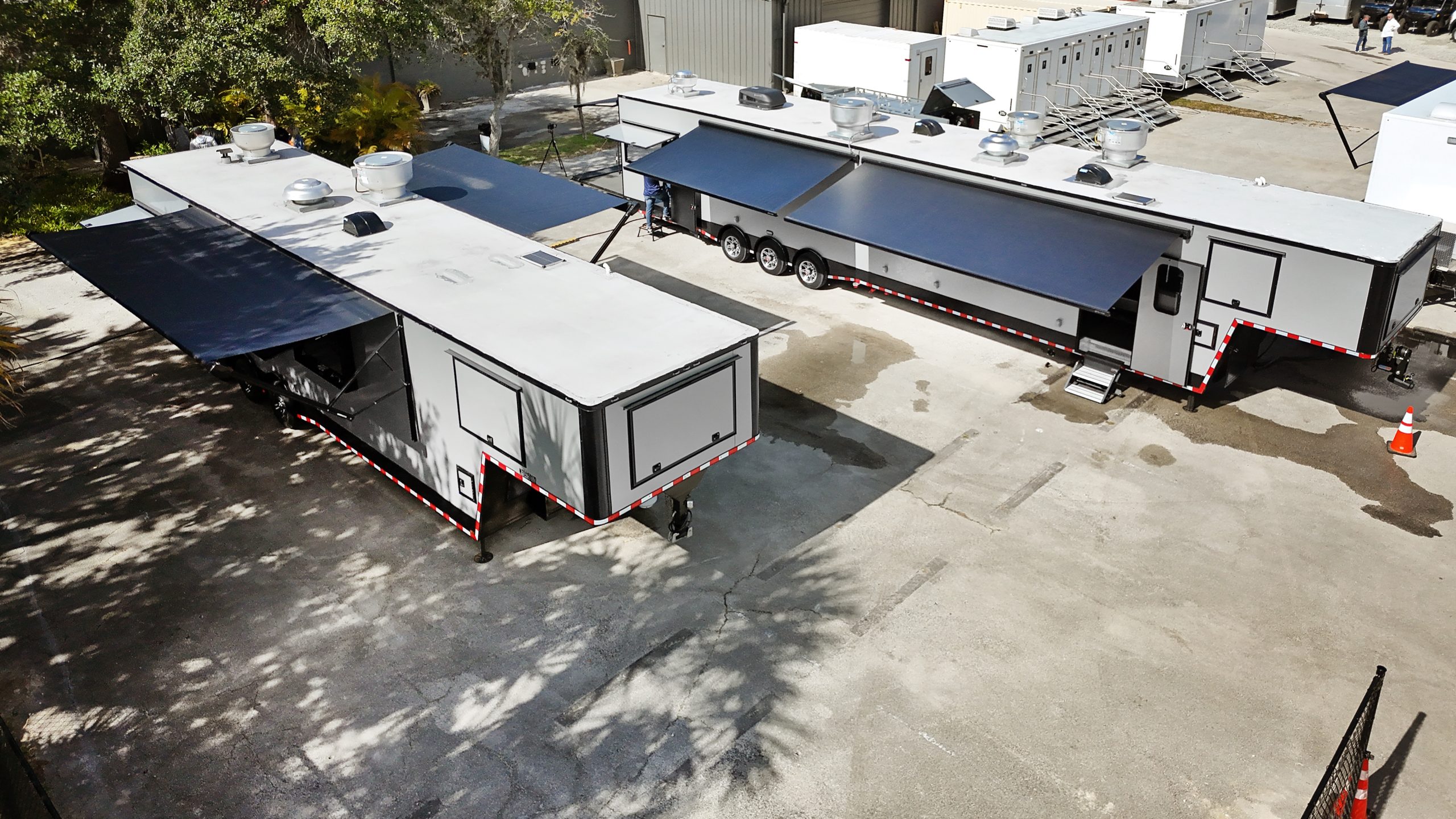
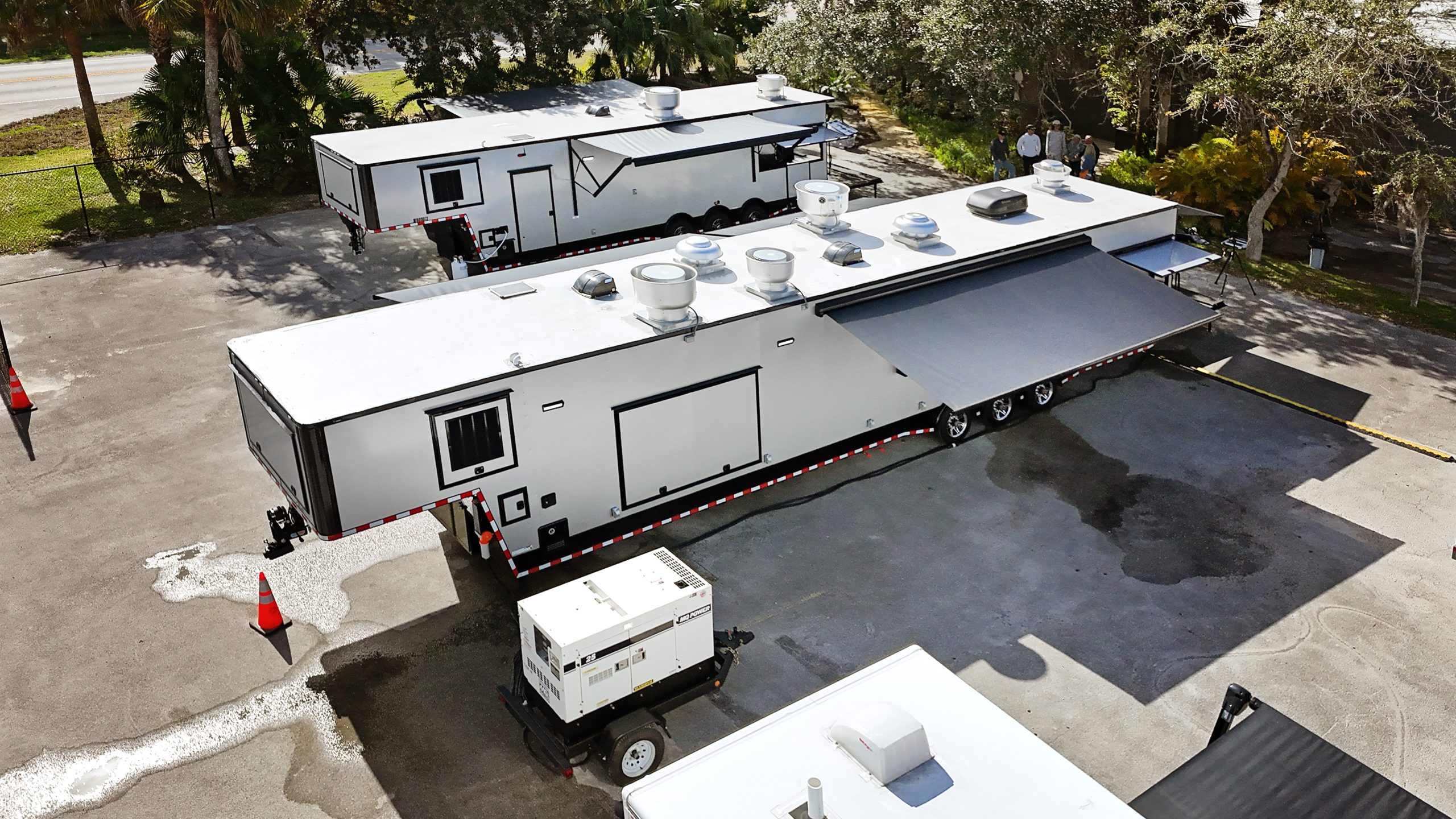
In 2024, SDG Trailers delivered what stands as the most documented, highest-capacity privately owned disaster relief kitchen fleet in the United States: the Junior and Big Papa, custom-built for Patriot Response Group (PRG) of Waycross, Georgia. PRG entered the emergency catering market in 2024 and immediately contracted SDG for a fleet capable of government-scale mass feeding. Together, the two trailers serve 5,000+ meals per day in disaster and emergency catering operations.
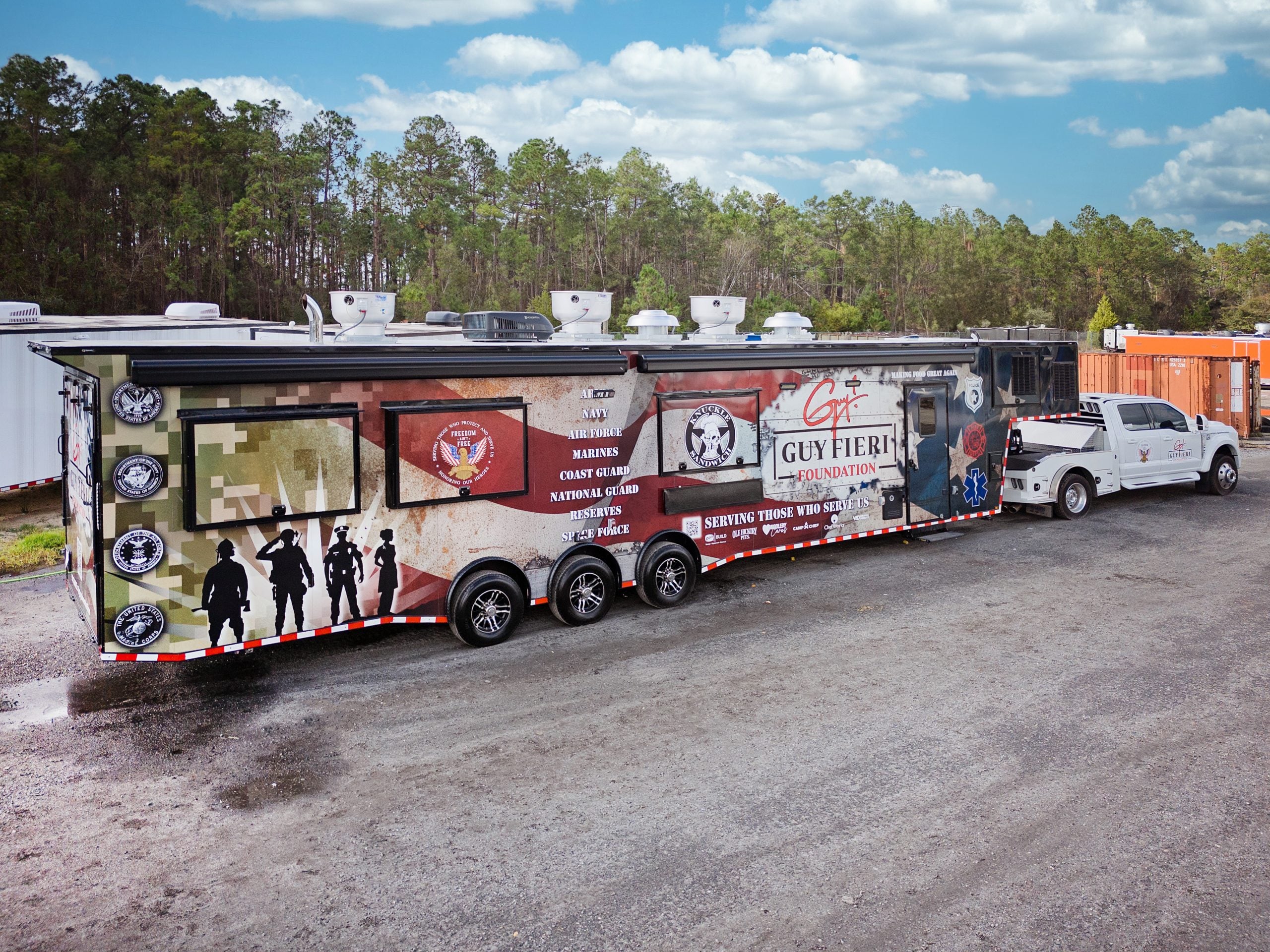
Junior – 40ft Mobile Kitchen
The Junior is a 40-foot bumper-pull kitchen trailer built around triple 7,000-lb axles, giving it a 21,000-lb GVWR. That’s not an oversight – it’s a requirement. Commercial kitchen equipment is heavy. Add 500 gallons of water, full propane tanks, crew gear, and a loaded food inventory, and you need every pound of that rating to move safely on the road.
Equipment inside the Junior:
- 60-inch commercial range – high-BTU, full-width cooking surface
- Double commercial ovens – for baking and roasting at scale
- Commercial griddles – for high-volume breakfast and protein searing
- Dual 40-lb commercial fryers – run simultaneously for throughput
- Southern Pride SPK-500-15 rotisserie – continuous BBQ-style mass protein production
The Junior operates as a self-contained unit. It can feed a site of 2,000-3,500 people per day on its own. Paired with Big Papa, the capacity more than doubles.
Big Papa – 52ft Gooseneck Kitchen
Big Papa is 52 feet of gooseneck. It carries dual full-size 20-rack commercial ovens, 40-gallon commercial tilt skillets, and an Old Hickory CTO double-wide smoker and BBQ unit. Pocket doors open the service side for an open-air serving line. Advanced AC airflow engineering keeps interior temperatures safe for sustained crew operation in Southern summer heat. Custom floor drains were engineered into the build from day one.
The gooseneck configuration matters. A 52-foot bumper-pull would be unwieldy on disaster zone access roads and parking lots. The gooseneck geometry gives Big Papa better weight distribution and easier maneuvering when deploying into tight urban disaster sites.
PRG now uses the Junior and Big Papa fleet to serve government agencies, NGOs, and large-scale emergency response events across the region.
No competitor has publicly documented a dual-trailer disaster kitchen fleet at this specification level. The PRG build represents a new benchmark for what a private emergency catering operator can deploy – and SDG’s documentation of it makes SDG the only manufacturer with verified proof of this capability.
Guy Fieri Foundation: Hurricane Relief Kitchen in Action
SDG-built kitchen equipment has served real communities after real disasters. In Holmes County, Florida, following a hurricane, the Guy Fieri Foundation ran a mass feeding operation using SDG-built trailer equipment. The operation fed first responders and displaced families directly from the field.
The setup: a full-service mass feeding station in a parking lot. No building. No fixed kitchen. Hot meals served to relief workers and community members who had nowhere else to turn.
That’s the real-world proof point. Not a trade show demo. Not a rendering. A working kitchen serving hurricane survivors. SDG also builds for Operation BBQ Relief, Tunnel to Towers Foundation, and the Riverside Sheriffs’ Association – organizations that deploy into the worst situations imaginable and need equipment that won’t fail them. For more on SDG’s full emergency response capabilities, see the emergency response trailer guide.
Off-Grid Capability: What It Takes to Feed 1,000+ People Without Shore Power
Off-grid mass feeding is a systems problem, not just an equipment problem. Every component – power, water, fuel, drainage – has to work together without any external infrastructure. Each system requires its own spec. Work through them in order:
Generator Sizing
A fully equipped disaster kitchen trailer draws significant electrical load. A single 40-lb fryer can pull 10-15kW on its own. Add HVAC, lighting, water pump, and commercial ovens, and the total load for a large trailer typically runs 30-60kW. For a dual-trailer fleet like PRG’s, generator capacity in the 60-100kW range is appropriate. The generator compartment should be ventilated, fuel-connected, and accessible for maintenance without entering the kitchen.
Water System
Freshwater tank sizing is a function of meal count and menu. A rough benchmark: 1.5-2 gallons of freshwater per meal served, including cooking water, cleaning, and handwashing. For a 1,000-meal-per-day operation, that’s 1,500-2,000 gallons of freshwater consumed daily. Most deployments resupply water daily from tanker trucks. Tank capacity on the trailer itself should cover at least a half-day of operations without resupply – 500-750 gallons minimum on a large rig.
Greywater Containment
Every gallon of freshwater used becomes greywater. Custom floor drains channel all kitchen runoff into sealed holding tanks. Greywater must be pumped out and disposed of properly – disaster zones don’t have sewer hookups. Tank sizing should match freshwater capacity. Plan for daily pumpout as part of site logistics.
Fuel Systems
Propane is the standard for mobile kitchens because it’s available everywhere, stores safely in tanks, and delivers consistent BTU output regardless of altitude or ambient temperature. Natural gas connections are an option for semi-permanent deployments. All-electric builds are emerging but require generator capacity that’s still cost-prohibitive for most operators at disaster-feeding scale.
Satellite Connectivity
Remote deployments increasingly include Starlink or similar satellite connectivity for inventory management, crew communication, and logistics coordination. This is becoming a standard spec request on new builds, especially for operators working with government agencies. Operators who also need incident command capabilities should review the mobile command trailer guide.
How to Spec a Disaster Relief Kitchen Trailer
Start with the mission. Work backwards to the metal.
Step 1 – Define your daily meal target. Are you feeding 500 people or 5,000? This single number drives every other decision. Be honest about peak demand, not average demand. Disasters don’t average.
Step 2 – Build the equipment list. Match equipment to your menu and volume. A pure BBQ operation needs a rotisserie and smoker. A breakfast-and-dinner program needs ranges, ovens, and griddles. A soup-and-stew operation needs tilt skillets. Don’t over-spec equipment you won’t use – it adds cost and weight.
Step 3 – Determine trailer size. Equipment list dictates floor plan, which dictates trailer length. Add 15-20% for circulation, storage, and crew movement. A cramped kitchen is a slow kitchen.
Step 4 – Specify axle count and GVWR. Fully loaded weight – equipment, water, fuel, food, crew gear – must stay under your GVWR with margin. For large builds, triple-axle configurations are standard. The PRG Junior’s triple 7,000-lb axles (21,000 lb GVWR) are a model for this class of trailer.
Step 5 – Design the power system. Size your generator for peak load plus 20% headroom. Specify connection type (shore power, generator, or dual-mode). Plan the generator compartment as part of the trailer structure, not an afterthought.
Step 6 – Design the water system. Size freshwater and greywater tanks to your daily meal target. Specify pump type, floor drain locations, and greywater disposal method before fabrication begins.
Step 7 – Confirm build timeline. SDG builds custom disaster kitchen trailers in 4-12 weeks depending on complexity. A standard large-format trailer is typically 6-8 weeks. A complex gooseneck build with custom systems like Big Papa is toward the 10-12 week end. Start early – disasters don’t give you lead time, but procurement can. SDG also offers financing options for qualified buyers.
Frequently Asked Questions
How many meals can a 40-foot kitchen trailer serve per day?
A properly equipped 40-foot disaster relief kitchen trailer – like the PRG Junior SDG built for Patriot Response Group – can produce 2,000-3,500 meals per day. Actual output depends on equipment configuration, crew size, and menu complexity. The PRG Junior achieves this range with a 60-inch commercial range, double ovens, dual 40-lb fryers, and a Southern Pride SPK-500-15 rotisserie running simultaneously.
What’s the difference between a concession trailer and a disaster relief kitchen trailer?
A concession trailer is built for retail food service: a set menu, moderate volume, and event-based deployment. A disaster relief kitchen trailer is engineered for sustained, high-volume mass feeding without shore power, municipal water, or fixed infrastructure. Key differences include generator capacity, independent water and greywater systems, heavy-duty HVAC for field conditions, and commercial-grade equipment rated for 12-16 hour daily operation over extended deployments.
Do disaster relief kitchen trailers need to be NSF certified?
Equipment inside the trailer should meet NSF/ANSI Standard 4, which governs commercial cooking equipment for sanitation and food-safety compliance (NSF International, NSF/ANSI 4, 2023). Whether the trailer itself requires a state mobile food unit permit depends on the deployment state and the operator’s agreement with local health authorities. Many government and NGO contracts specify NSF-compliant equipment as a baseline requirement. SDG can spec NSF-compliant equipment as part of any build.
How long does it take SDG to build a custom disaster kitchen trailer?
SDG Trailers builds custom disaster kitchen trailers in 4-12 weeks from confirmed order. A standard large-format bumper-pull kitchen is typically 6-8 weeks. Complex builds – like the 52-foot gooseneck PRG Big Papa with custom airflow engineering and integrated floor drainage – run 10-12 weeks. SDG ships to all 50 states and internationally, and financing is available for qualified buyers.
Can SDG build a trailer that meets FEMA mass feeding specifications?
Yes. FEMA’s Mass Care/Emergency Assistance guidelines specify minimum caloric output per person per day and operational standards for mass feeding sites (FEMA, Mass Care/Emergency Assistance, 2021). SDG builds to operator-defined specifications, which can include equipment lists, capacity targets, and power/water system requirements aligned with FEMA mass feeding standards. The PRG fleet – serving 5,000+ meals per day for government agencies and NGOs – demonstrates SDG’s capacity to build at FEMA-relevant scale.
Build Your Disaster Relief Kitchen Trailer With SDG
SDG Trailers has been building custom trailers since 2001. The PRG Junior and Big Papa are the most capable private disaster-relief kitchen trailers ever publicly documented. The Guy Fieri Foundation deployment in Holmes County proved the concept in a real hurricane relief operation.
If your organization – a government agency, NGO, emergency catering company, or disaster response foundation – needs a custom mass feeding trailer, SDG builds to your spec, in your timeline, and ships anywhere in the country.
SDG Trailers
2255 Industrial Blvd, Waycross, GA 31503
(800) 380-9743
sdgtrailers@gmail.com
Mon-Fri: 8AM-7PM
Request a custom build quote | See all disaster relief trailers | Financing available
Written by the SDG Trailers Team. SDG Trailers (Southern Dimensions Group) has manufactured custom trailers in Waycross, Georgia since 2001. The company builds for government agencies, NGOs, emergency response organizations, and commercial operators across all 50 states.
Citation Capsules
Capacity Section: A fully equipped 40-foot disaster relief kitchen trailer can serve 2,000-3,500 meals per day. At 52 feet with dual 20-rack ovens and 40-gallon tilt skillets, the PRG Big Papa built by SDG Trailers (Waycross, GA, 2024) reaches 3,500-5,000+ meals per day. The combined PRG fleet serves 5,000+ meals daily. (SDG Trailers first-party build data, 2024)
Standards Section: NSF/ANSI Standard 4 governs commercial cooking equipment in mobile food environments, requiring that all food-contact surfaces and cooking equipment meet defined sanitation standards for commercial use. (NSF International, NSF/ANSI 4: Commercial Cooking Equipment, 2023)
FEMA Standards Section: FEMA’s Mass Care/Emergency Assistance program guidelines specify minimum caloric thresholds of 2,100 calories per person per day for disaster-affected populations, establishing the output benchmark that mass feeding kitchen trailers must meet. (FEMA, Mass Care/Emergency Assistance Guidelines, 2021)