
Disaster Relief Trailers: 5 Types, Specs & Costs (2026)
A disaster relief trailer is a custom-built, road-deployable unit equipped for a specific emergency response function: mass feeding, incident command, crew housing, sanitation, or multi-purpose logistics. It’s designed to operate fully off-grid at an active disaster site. Unlike standard utility trailers, disaster relief trailers are engineered around mission-critical uptime: they must arrive, set up, and perform the same day.
This guide covers everything buyers need to know: the five main types, real-world builds SDG has completed (including Patriot Response Group’s 5,000-meal-per-day fleet), technical specifications by trailer class, pricing ranges, and how to spec and order a custom unit. Whether you represent a county emergency management office, an NGO, or a utility company rebuilding after a storm, this is your complete reference.
Explore SDG’s full disaster relief trailer overview for specs and photos of every build type in the lineup.
Key Takeaways
- A disaster relief trailer is a self-contained, road-deployable unit built for a specific emergency mission: feeding, command, crew housing, or sanitation
- SDG builds 5 types: mobile kitchen, mobile command center, emergency response, bunk/crew housing, and restroom/sanitation trailers
- Real deployments include the PRG fleet (5,000+ meals/day), the Guy Fieri Foundation (hurricane relief, Holmes County FL), Operation BBQ Relief, and Tunnel to Towers Foundation
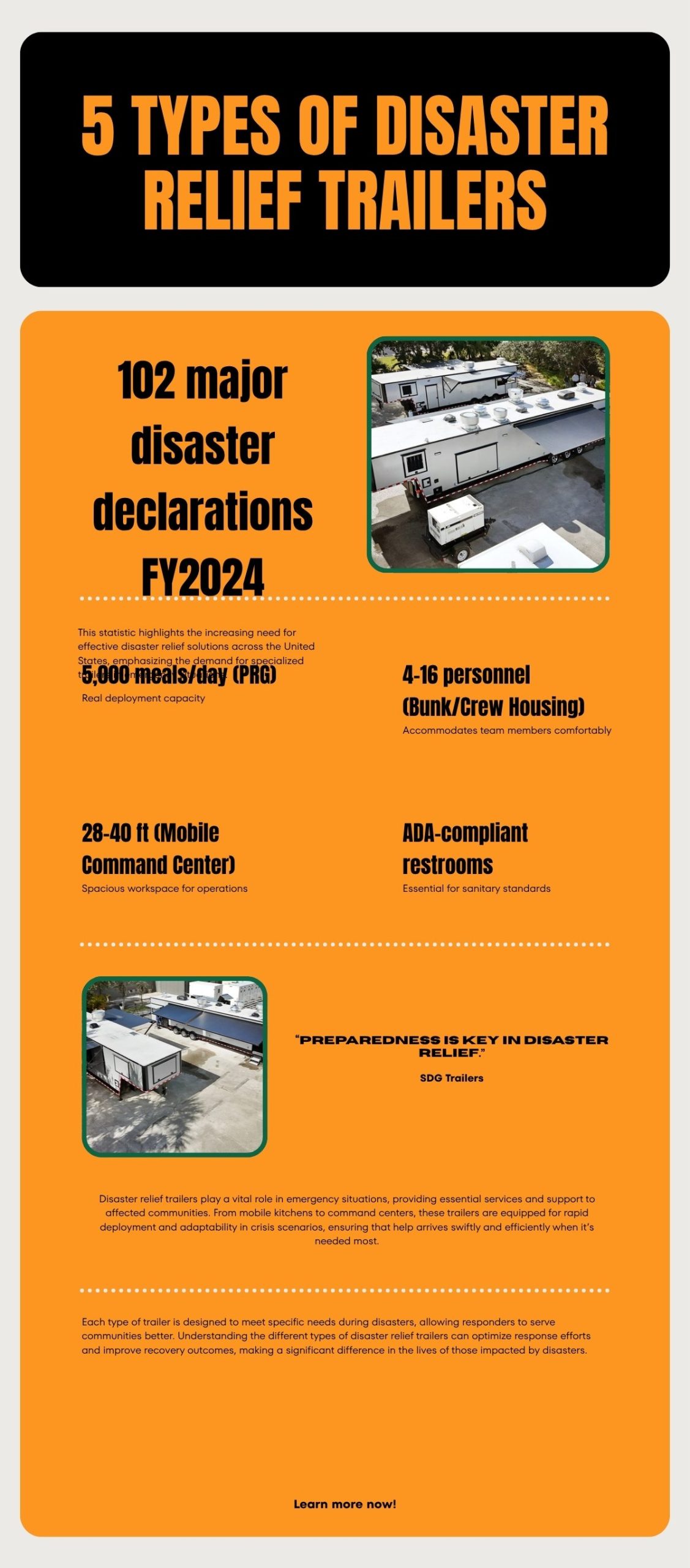
- FEMA issued 102 major disaster declarations in fiscal year 2024 (FEMA, 2024), creating sustained demand for rapid-deploy response assets
- SDG ships all 50 states and internationally; build times are 4-12 weeks depending on complexity
- Pricing ranges from $15,000 for compact units to $400,000+ for heavy-duty gooseneck mass-feeding rigs; financing is available
What Is a Disaster Relief Trailer?
Disaster relief trailers are purpose-built response assets, not modified commercial trailers. They’re engineered from the frame up for rapid deployment, high-cycle daily use, and off-grid operation. FEMA’s National Response Framework identifies mobile feeding, mobile command, and sanitation as three of the six core mass care functions (FEMA National Response Framework, 2023), and trailers are the most cost-effective way to deliver all three.
Standard commercial trailers are built for freight. Disaster relief trailers are built for people: the people working a disaster site and the people displaced by it. The difference shows up in every spec: heavier axle ratings, generator hookups, NSF-certified commercial kitchen equipment, ADA-compliant layouts, and structural engineering that accounts for uneven terrain and field conditions.
Why custom-built outperforms off-the-shelf. Pre-configured “disaster response kits” exist, but they’re a compromise. Your mission has a specific feeding capacity, a specific headcount for crew housing, a specific jurisdictional compliance requirement. A custom-built trailer meets those numbers exactly. It’s also built to your brand and equipment preferences. No ripping out a gas range to swap in the griddle configuration your kitchen team needs. SDG’s custom trailer manufacturing process starts with your specs, not a catalog page.
What Are the 5 Types of Disaster Relief Trailers?
SDG Trailers builds all five categories. Each type serves a distinct ICS (Incident Command System) function, and most large-scale responses require two or more types operating in coordination.
Based on SDG’s disaster relief builds since 2001, mobile kitchen trailers represent the highest-volume request category, typically the first call after a major weather event. Mobile command units are the second-highest, followed by emergency response multi-purpose trailers.
Mobile Kitchen Trailers
Mobile kitchen trailers are the backbone of disaster feeding operations. A properly spec’d unit can produce 1,000 to 5,000+ meals per day, hot, on-site, for first responders and displaced families. They run on LP or natural gas, with onboard generator hookups, commercial hood-and-exhaust systems, NSF-certified equipment, and water tanks sized for field operation.
Key specs to look for: BTU output of the range or cooktop, oven rack count, fryer capacity (40 lb minimum for high-volume), rotisserie capacity if you’re doing large-batch protein, and the GVWR relative to your tow vehicle.
Real deployments run the full spectrum. A 20-ft unit serves 200-500 meals per day for a quick-deploy NGO response. A 52-ft gooseneck like SDG’s “Big Papa” handles 5,000+ meals when fully staffed and provisioned. For a complete spec breakdown and deployment guide, see SDG’s disaster relief mobile kitchen guide.
Mobile Command Center Trailers
Mobile command center trailers give incident commanders a hardened, climate-controlled workspace anywhere in the field. They house communications equipment, workstations, display screens, secure storage, and power conditioning for sensitive electronics. Sheriff departments, state emergency operations centers, and military contractors all use them as forward EOC (Emergency Operations Center) deployments.
The Riverside Sheriffs’ Association is one of SDG’s command center clients, a jurisdiction that needs a field-deployable command unit supporting multi-agency operations at a moment’s notice.
These trailers typically run 28-40 ft, with a GVWR between 14,000 and 26,000 lbs. Internal layout is fully custom: wall-mounted screens, equipment racks, conference seating, and exterior cable pass-throughs for antenna and fiber connections. See SDG’s mobile command trailer guide for detailed specs and configuration options.
Emergency Response Trailers
Emergency response trailers are the multi-tool of disaster response. Configured for ICS compatibility, they support multiple functions: equipment storage, triage staging, logistics coordination, or rapid first-response supply deployment. They’re the trailers that show up first, before the kitchen and command units roll in.
They’re popular with utility companies, county fire departments, and municipal emergency management offices that need a single deployable asset covering multiple mission types. Typical configurations include floor-to-ceiling storage, fold-out workstations, exterior equipment access panels, and generator or shore-power hookups. See SDG’s emergency response trailer guide for full configuration specs.
Bunk Trailers / Crew Housing
Extended disaster operations last days or weeks. Crew housing trailers keep response teams on-site, rested, and rotation-ready without burning hours on hotel commutes. SDG builds bunk trailers with sleeping quarters, climate control, and basic amenities sized for 4-16 personnel depending on length.
These units are common in wildfire response, utility line restoration, and federal government contractor deployments. They’re also used by relief NGOs running extended field programs in communities with limited lodging infrastructure.
Restroom and Sanitation Trailers
ADA-compliant, self-contained restroom trailers are a sanitation necessity at any disaster site hosting large numbers of displaced residents or field workers. SDG builds these units with freshwater storage, waste holding tanks, climate control, and exterior hookups for water and dump-station access.
Sanitation trailers are often procured alongside mobile kitchens and command units as part of a complete response package. They must meet ADA requirements and local health codes, which vary by state. SDG’s team handles compliance spec work as part of every custom build.
Who Deploys Disaster Relief Trailers?
FEMA issued 102 major disaster declarations in fiscal year 2024 (FEMA Disaster Declarations Summary, 2024), generating thousands of individual response deployments across federal, state, NGO, and private-sector entities. That sustained declaration volume means sustained demand for mobile response assets that can be pre-positioned and deployed on 24-hour notice.
The buyer landscape for disaster relief trailers is broad. Here are the primary deploying organizations:
Federal agencies. FEMA, HHS, and DoD contractors all maintain trailer fleets for disaster feeding, command, and logistics support. Federal contracts often require specific GVWR certifications, NSF compliance, and DOT compliance for interstate towing.
State and county emergency management offices. Most states now pre-fund emergency response infrastructure under the Homeland Security Grant Program. County-level EMAs typically buy one to three trailers and pre-position them at a central depot for rapid dispatch.
Faith-based and nonprofit organizations. Operation BBQ Relief, Tunnel to Towers Foundation, World Central Kitchen, and hundreds of smaller faith-based organizations run mobile feeding programs using custom kitchen trailers. SDG has built for both Operation BBQ Relief and Tunnel to Towers Foundation.
Utilities and energy companies. Power and telecom utilities deploy mobile command and crew housing trailers for major restoration events: hurricanes, ice storms, and wildland fires. Extended deployments (7-21 days) make crew housing trailers particularly valuable.
Military and federal contractors. Patriot Response Group, which operates under federal contract for mass disaster feeding, is one of SDG’s most prominent disaster relief clients. Their fleet capacity of 5,000+ meals per day makes them one of the largest mobile kitchen operators in the country.
Sheriff departments and law enforcement. Mobile command centers are standard equipment for departments handling large-scale incidents: active searches, mass casualty events, and extended operations requiring field command infrastructure.
SDG Trailers: Real Disaster Relief Builds
SDG Trailers has been building custom trailers in Waycross, GA since 2001. The company’s disaster relief work isn’t theoretical. It’s documented, deployed, and feeding people in the field today.
SDG’s disaster relief builds have taught us that clients almost always underestimate daily meal volume in early planning conversations. A good rule: if you’re estimating 1,000 meals per day, spec for 1,500. Disaster conditions drive demand spikes that exceed initial projections within the first 24 hours of operation.
Patriot Response Group: 5,000 Meals Per Day
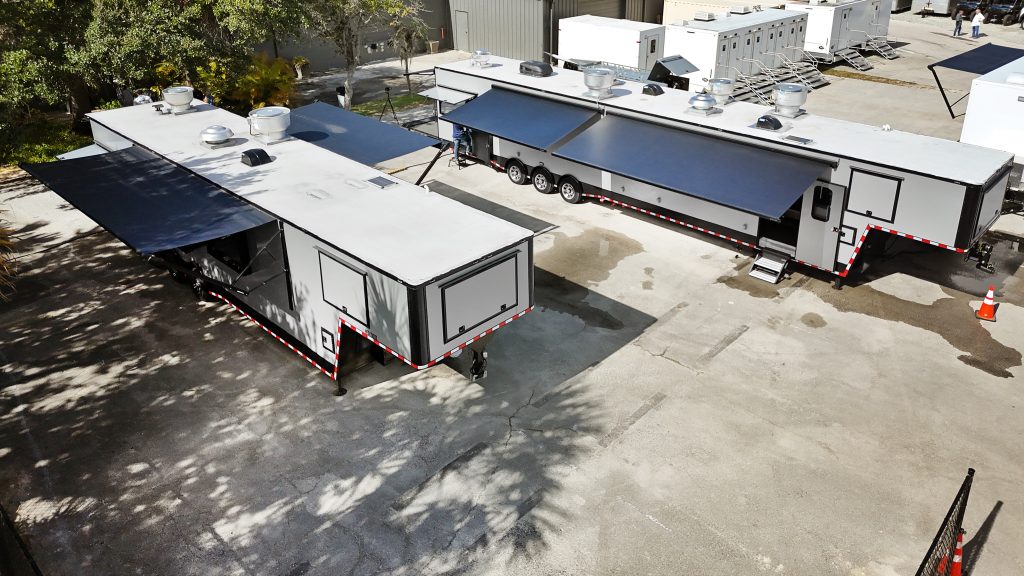
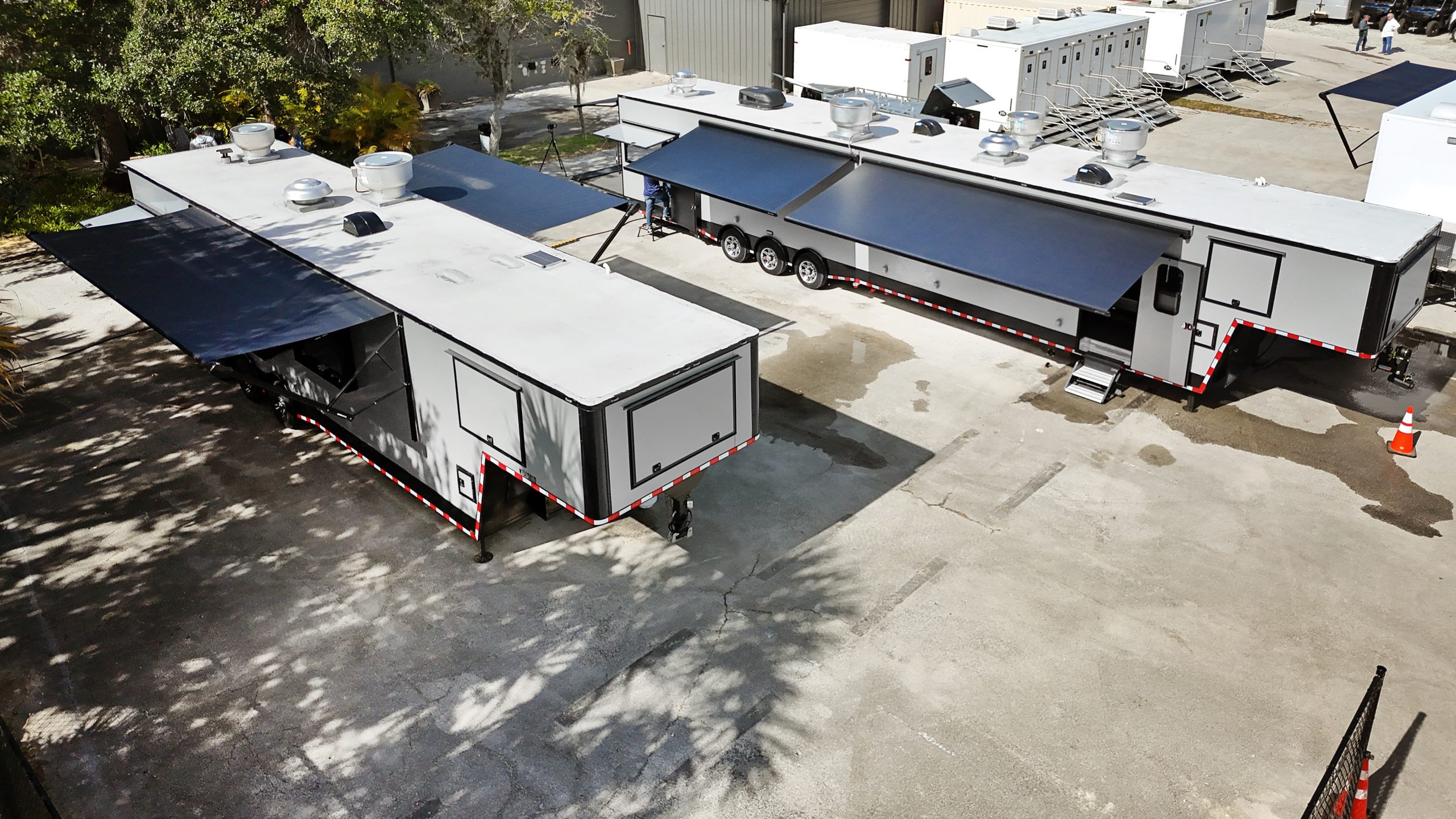
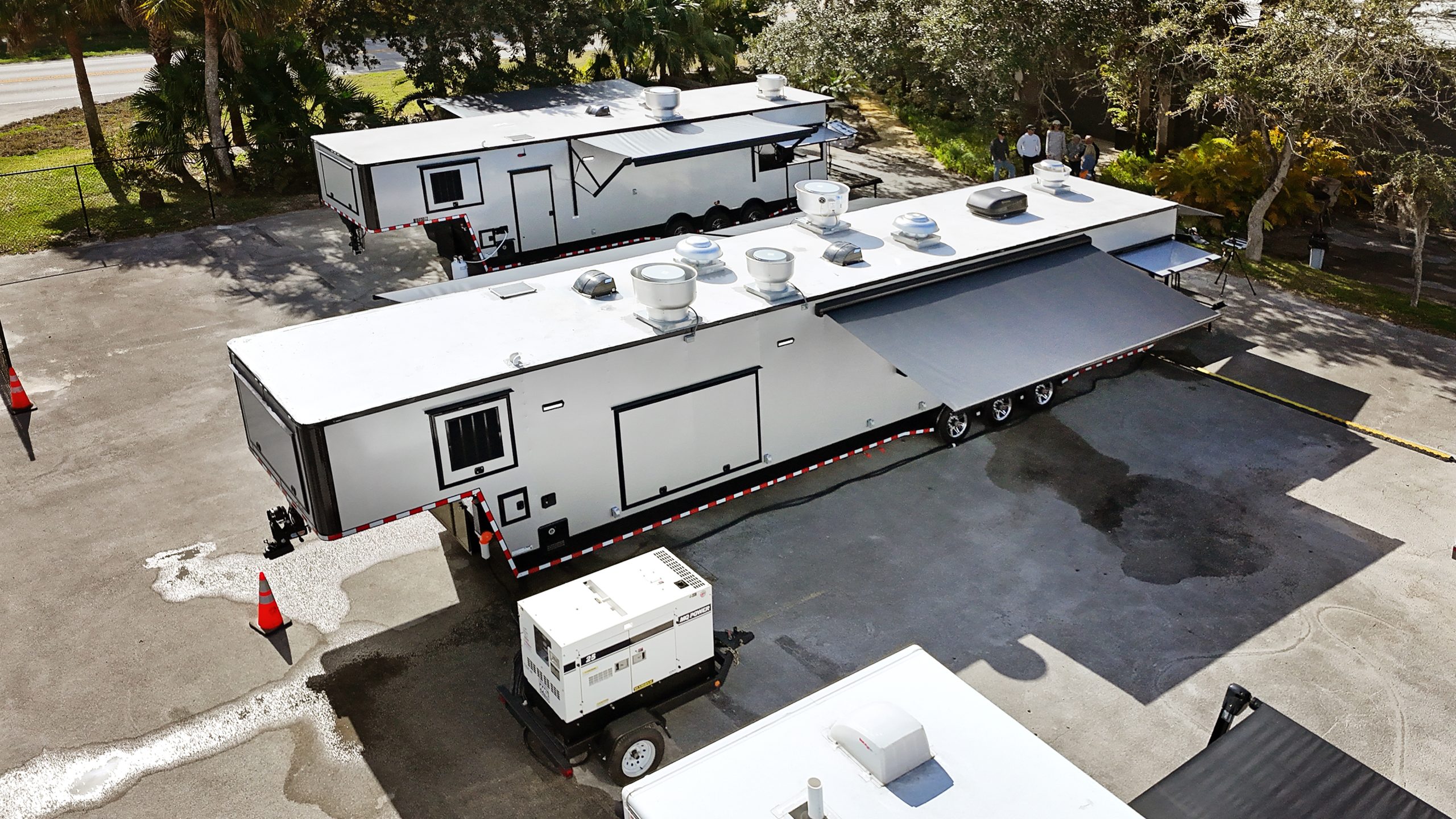
Patriot Response Group (PRG) is a federal disaster relief contractor that deploys mobile kitchen operations at major disaster sites across the US. SDG built their flagship mobile kitchen fleet: “Junior” (40 ft) and “Big Papa” (52-ft gooseneck). Together, the two units serve 5,000+ meals per day in active disaster zones.
Junior – 40-foot mobile kitchen trailer:
- Triple 7,000-lb axles (21,000-lb combined axle capacity)
- 60-inch commercial range
- Double ovens
- Commercial griddles
- Dual 40-lb commercial fryers
- Southern Pride SPK-500-15 rotisserie
- Full commercial hood-and-exhaust ventilation
- NSF-certified food contact surfaces throughout
Big Papa – 52-foot gooseneck mobile kitchen trailer:
- Dual full-size 20-rack commercial ovens
- 40-gallon commercial tilt skillets
- Old Hickory CTO double-wide smoker
- Pocket doors for operational flexibility
- Advanced AC airflow engineering for high-heat environments
- Custom floor drains for high-volume kitchen operation
- Full commercial hood-and-exhaust system
The PRG fleet represents what’s possible when a disaster relief contractor works with a builder who understands both field operations and commercial kitchen engineering. These aren’t modified food concession trailers. They’re purpose-built mass feeding systems.
Guy Fieri Foundation: Hurricane Relief in Holmes County, FL
After a hurricane struck Holmes County, FL, the Guy Fieri Foundation deployed disaster relief feeding operations to support first responders and displaced families in the field. SDG Trailers built the equipment used in that deployment: a mobile kitchen unit configured for rapid-deploy field feeding.
The Guy Fieri Foundation’s disaster relief work focuses on reaching underserved rural communities that are often the last to receive organized relief services after a major weather event. Holmes County fits that profile exactly: a rural Florida panhandle community where mobile feeding infrastructure makes a direct difference in recovery outcomes.
This build demonstrates the range of SDG’s client base. The same engineering capability that produces a 5,000-meal-per-day federal contractor fleet also serves foundation-funded community relief programs.
Operation BBQ Relief and Tunnel to Towers Foundation
SDG has also built for two of the most recognized NGO disaster relief brands in the country. Operation BBQ Relief mobilizes volunteer pitmasters to cook and serve hot meals at disaster sites nationwide. Their model requires rugged, high-volume trailers that can handle both competition-style BBQ cooking and mass feeding volumes.
Tunnel to Towers Foundation runs its own disaster response program in addition to its core veteran-housing mission. SDG’s builds for both organizations reinforce a consistent pattern: the organizations doing the most effective disaster relief work use custom-built trailers because off-the-shelf equipment can’t keep up with field demands.
Disaster Relief Trailer Specs: What to Look For
Choosing the right trailer class starts with your mission profile: how many people do you need to feed, house, or support? How far are you deploying? What’s your tow vehicle capacity?
Key Specs to Evaluate
GVWR and axle count. Gross Vehicle Weight Rating determines your legal towing requirements and road capability. A compact 16-ft unit may run 7,000-14,000 lbs GVWR and require only a 3/4-ton pickup. A heavy-duty 52-ft gooseneck like Big Papa runs triple axles and requires a Class 8 tractor or heavy-duty commercial truck. Get your tow vehicle confirmed before finalizing trailer specs.
Generator capacity. Off-grid operation requires onboard or trailer-mounted generator capacity matched to total electrical load. For a full commercial kitchen, 30-50 kW is typical. Command centers running multiple workstations and climate control may need 20-35 kW. Under-spec’d generators cause equipment failures at the worst possible moment.
Water tank and waste holding capacity. Field sites often lack potable water hookups. A mobile kitchen trailer needs minimum 300-500 gallons of freshwater storage for high-volume operation. Waste holding must be sized to match. Under-size it and you’ll be draining tanks mid-shift.
HVAC design. High-BTU cooking equipment generates enormous heat. Proper commercial hood-and-exhaust design, combined with precision AC airflow engineering (as SDG used in Big Papa), keeps internal temperatures in a range where kitchen staff can work safely through a full operational day.
Floor drains and cleanability. NSF food-safety standards and practical field sanitation both require floor drains positioned for full wash-down capability. This is an engineering detail that gets overlooked in off-the-shelf builds and becomes a daily problem in the field.
| Class | Length | GVWR | Daily Feed Capacity | Best Use |
|---|---|---|---|---|
| Compact | 16-24 ft | Up to 14k lbs | 200-500 meals | Quick-deploy, NGOs, first response |
| Standard | 28-36 ft | 14k-26k lbs | 500-2,000 meals | Mid-scale county/state response |
| Heavy-Duty | 40-53 ft | 26k+ lbs | 2,000-5,000+ meals | Mass disaster, FEMA, federal contractors |
How Do You Buy a Disaster Relief Trailer?
Buying a custom disaster relief trailer is a four-step process. The lead time is 4-12 weeks depending on build complexity, so procurement needs to start well before the event season, not during it.
Step 1: Assess your mission profile. Define the specific function (feeding, command, housing, sanitation, multi-purpose). Estimate peak daily operational demand: meals served, personnel housed, vehicles supported. Identify your tow vehicle and confirm GVWR capacity. Know your state DOT requirements for trailer length and weight.
Step 2: Define your spec requirements. Translate mission profile into specifications: trailer length, GVWR, axle count, generator requirement, water/waste tank sizing, equipment list, and compliance requirements (NSF, ADA, state health code). SDG’s sales team works through this process with every new client. It’s a structured conversation, not a catalog lookup.
Step 3: Request a quote. SDG provides factory-direct quotes with full itemized specs. There’s no dealer markup. The quote includes materials, fabrication labor, equipment installation, and delivery. Complex builds may require a preliminary design phase before final quote.
Step 4: Confirm build timeline and schedule delivery. SDG’s 4-12 week build window depends on complexity and current shop load. Simple compact builds can deliver in 4-6 weeks. Heavy-duty gooseneck builds with full commercial kitchens typically run 8-12 weeks. Delivery to all 50 states is standard; international shipping is available. Request a quote to confirm current build slot availability for your project.
The factory-direct advantage. SDG builds everything in-house at its Waycross, GA facility. No subcontracted fabrication, no resold inventory. Every weld, every equipment installation, every compliance spec is done by the same team that designed the build. That matters when you need a trailer that performs in the field, not just on a showroom floor.
How Much Does a Disaster Relief Trailer Cost?
Custom disaster relief trailers range from approximately $15,000 for a basic compact emergency response unit to $400,000 or more for a heavy-duty gooseneck mobile kitchen with full commercial equipment. Cost is driven primarily by trailer length, axle configuration, equipment specification, and custom fabrication complexity. (Source: SDG Trailers factory-direct pricing, 2026.)
Cost varies significantly by type and size. Here are the realistic ranges:
Compact emergency response trailers (16-24 ft): $15,000-$60,000. Base units with storage and basic power hookups run toward the low end. Units with integrated generator, workstations, and specialized equipment run higher.
Standard mobile kitchen trailers (28-36 ft): $60,000-$180,000. Equipment spec drives cost in this range more than length does. A 32-ft trailer with a full commercial range, double ovens, and fryers costs significantly more than a 32-ft trailer with light-duty cooking equipment.
Heavy-duty gooseneck mobile kitchens (40-53 ft): $180,000-$400,000+. The PRG Big Papa build sits in this category. Triple-axle configuration, full commercial kitchen, advanced HVAC engineering, custom floor drains, and premium brand-name equipment (Old Hickory, Southern Pride) push these builds to the upper end of the range.
Mobile command centers (28-40 ft): $80,000-$250,000. Electronics, AV systems, secure communications infrastructure, and custom millwork for workstations are the primary cost drivers.
Bunk and crew housing trailers (24-40 ft): $40,000-$150,000. Bunk count, climate system capacity, and fixture quality are the primary variables.
Financing. SDG offers financing for qualified buyers. Fleet orders for government agencies, NGOs, and private contractors can be structured with extended terms. Learn more on the financing page.
Bulk fleet orders. Organizations building a multi-unit fleet, like PRG’s Junior + Big Papa combination, can discuss fleet pricing directly with SDG’s team. Multi-unit builds allow for shared design work and coordinated delivery scheduling.
Frequently Asked Questions About Disaster Relief Trailers
What trailer is best for feeding 500 people per day?
A standard 28-32 ft mobile kitchen trailer is well-suited for 500 daily meals. You’ll want a minimum 60-inch commercial range, double ovens, at least one 40-lb fryer, and 300+ gallons of onboard water. A 13,000-16,000 GVWR unit in this range can be towed with a 1-ton pickup and still carry full commercial equipment. SDG’s food trailer team can walk you through the exact spec for your volume target. Browse the food and concession trailers lineup for standard configurations in this capacity range.
How fast can SDG build and ship a disaster relief trailer?
Build times run 4-12 weeks depending on build complexity and current production schedule. Simple compact builds (16-24 ft) with standard equipment can deliver in 4-6 weeks. Complex heavy-duty builds with full commercial kitchens and custom fabrication typically run 8-12 weeks. SDG ships to all 50 states and internationally. For time-sensitive procurement, contact SDG directly to confirm current availability and build slot timing.
Can disaster relief trailers operate fully off-grid?
Yes, with proper specification. Off-grid capability requires an onboard or trailer-mounted generator sized to match total electrical load, freshwater storage tanks (minimum 300-500 gallons for kitchen operations), waste holding capacity, and LP or natural gas fuel storage. SDG engineers off-grid operation into disaster relief builds by default. All PRG fleet units are fully self-sufficient for extended off-grid deployment.
Do SDG’s disaster relief trailers meet FEMA specs?
SDG builds to FEMA guidelines and the National Response Framework’s mass care standards, including NSF-certified commercial food equipment, ADA compliance for sanitation units, and DOT compliance for interstate towing. Specific federal contract compliance requirements (SAM.gov registration, GSA schedule equivalents) should be discussed with SDG’s team during the spec phase, as requirements vary by contract vehicle and agency.
Can I get financing for a disaster relief trailer?
Yes. SDG offers financing for qualified buyers, including government agencies, nonprofit organizations, and private contractors. Financing terms and eligibility depend on creditworthiness and order size. Fleet orders and multi-unit purchases can typically be structured with more flexible terms than single-unit orders. Visit the financing page or call (800) 380-9743 to discuss your situation directly.
What’s the difference between a disaster response trailer and a standard concession trailer?
The engineering, primarily. Standard concession trailers are built for event use: lighter axle ratings, smaller water tanks, consumer-grade or light-commercial equipment, no off-grid power provision. Disaster relief trailers are built for continuous heavy-duty deployment in uncontrolled field conditions. They run heavier axles, larger water and waste tanks, full commercial NSF-rated equipment, robust generator provisions, and structural engineering for uneven terrain. You can see the difference clearly in the PRG builds: the Big Papa’s triple axle configuration, 40-gallon tilt skillets, and advanced AC airflow engineering have nothing in common with a standard concession trailer spec.
Get a Quote from SDG Trailers
SDG Trailers has been building custom disaster relief trailers since 2001. The disaster relief work, from Patriot Response Group’s mass feeding fleet to the Guy Fieri Foundation’s hurricane response deployment, is built the same way every other SDG trailer is built: in-house, factory-direct, engineered for the specific mission.
If you’re sourcing a disaster relief trailer, whether one unit or a full fleet, start with a conversation. SDG’s team works through your mission profile, spec requirements, and timeline before a single dollar changes hands.
Call (800) 380-9743. Phones are answered Monday through Friday, 8 AM to 7 PM.
Email sdgtrailers@gmail.com with your project specs for a written quote.
Visit or ship to: 2255 Industrial Blvd, Waycross, GA 31503
SDG ships all 50 states and internationally. Build times: 4-12 weeks. Financing available.
Request a Quote | See All Disaster Relief Trailers | Financing
Author: SDG Trailers Team | Southern Dimensions Group | Waycross, GA 31503 | (800) 380-9743