
Emergency Response Trailer: Types, Specs & Costs (2026)
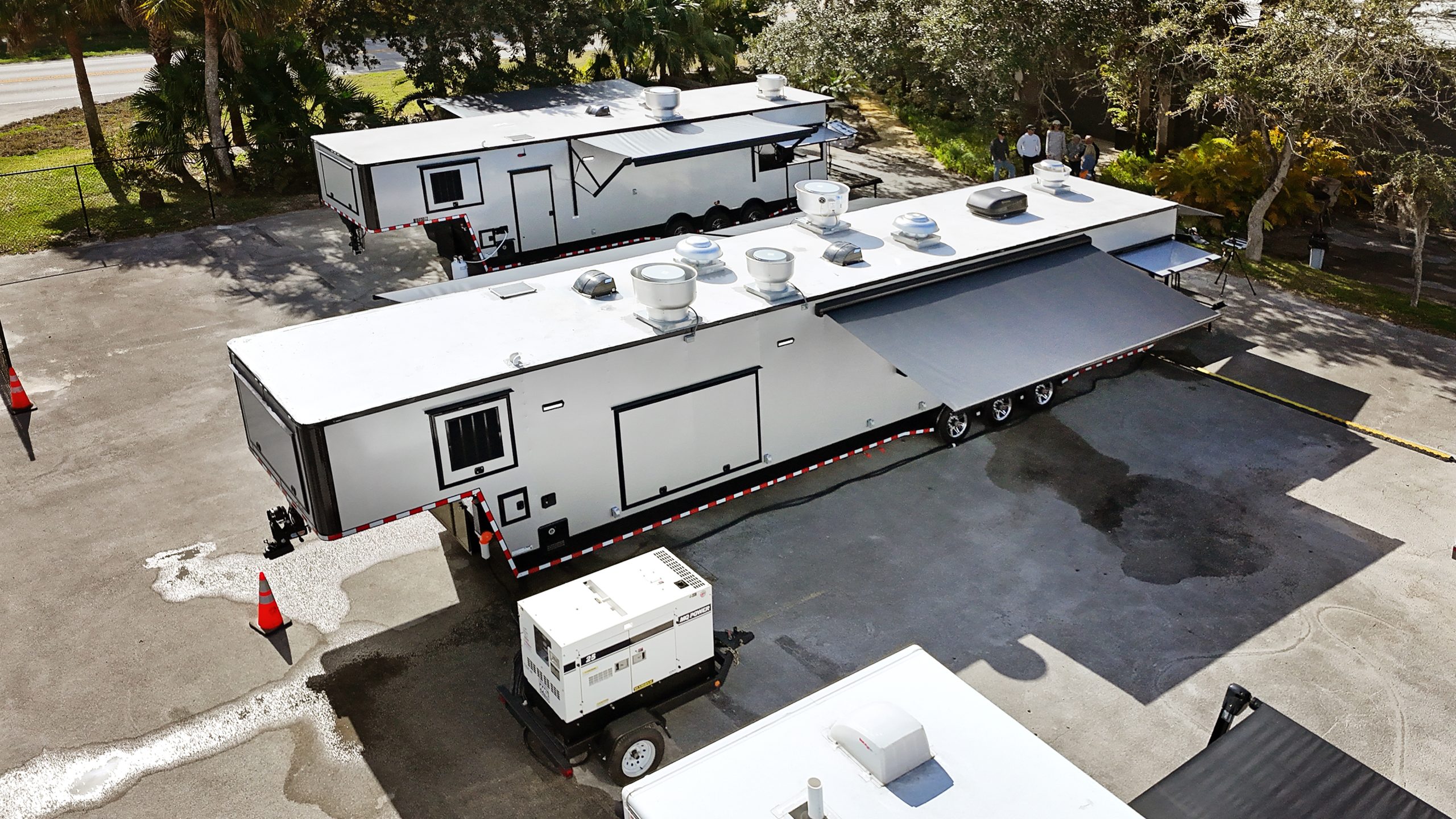
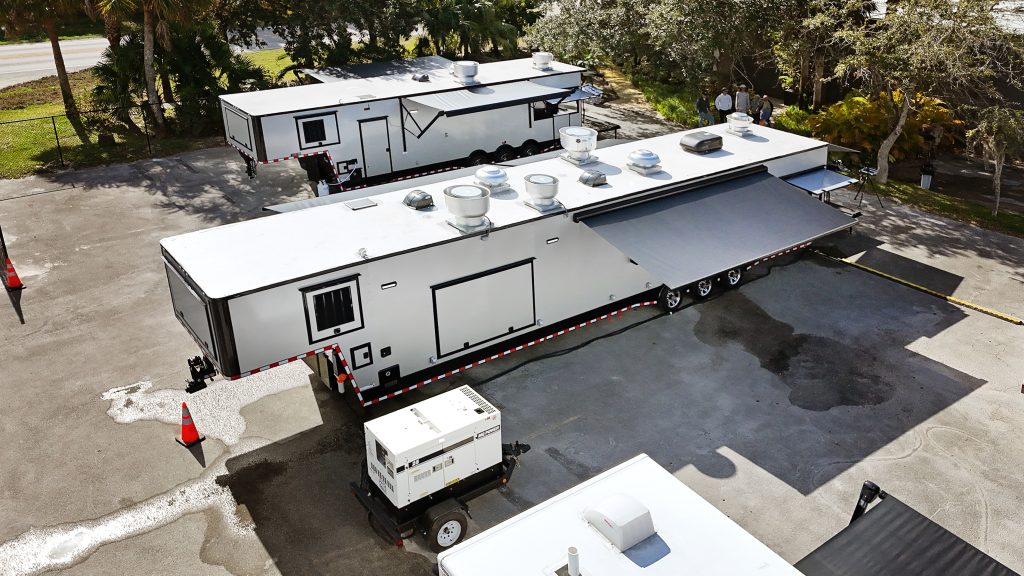
An emergency response trailer is a purpose-built, towable unit that gives incident commanders a deployable asset for command, feeding, shelter, sanitation, or supply operations at any disaster site. Unlike a standard utility trailer, these units are engineered from the ground up for rapid deployment, harsh conditions, and sustained multi-day operations under ICS and NIMS frameworks.
This guide covers everything your agency, department, or nonprofit needs to evaluate, spec, and procure a custom emergency response trailer: weight class and power systems, real-world deployment examples, and current pricing benchmarks. For a full overview of all trailer types SDG builds for disaster response, visit the disaster relief trailers page.
Key Takeaways
- An emergency response trailer is a purpose-built towable unit for command, feeding, shelter, or supply operations at disaster sites.
- Five core types exist: mobile command, mobile kitchen, mobile restroom, crew bunk, and refrigerated/supply trailers.
- Primary users include FEMA, state emergency management agencies, fire departments, law enforcement, NGOs, and military contractors.
- GVWR class determines your tow vehicle requirement and deployment capability. Most emergency kitchen trailers fall in the medium-duty range (10,001-26,000 lbs).
- According to FEMA’s National Response Framework, pre-positioned and rapidly deployable equipment is a core requirement of effective mass-care operations (FEMA.gov, 2023).
What Is an Emergency Response Trailer?
An emergency response trailer is a towable, self-contained unit designed for rapid deployment at disaster sites, mass-casualty incidents, or extended field operations. FEMA’s National Response Framework (2023) identifies mobile support assets as essential components of Emergency Support Function #6 (ESF-6), which governs mass-care, emergency assistance, temporary housing, and human services (FEMA.gov, 2023). These trailers are not general-purpose. Every system, from wiring to water storage to wall insulation, is specified for operational reliability when the infrastructure around them has failed.
See the disaster relief trailer guide for a full breakdown of how the five trailer types map to different operational missions.
The difference from a standard trailer is structural and functional. A concession trailer can operate in a parking lot with a power hookup. An emergency response trailer must operate without any hookup at all. That means onboard generators, independent water tanks, grey-water capture, satellite communications, and HVAC capable of running in both Florida summer heat and Midwest winter cold.
ICS and NIMS compatibility matters. The National Incident Management System (NIMS) requires that command operations maintain unified command structures even across jurisdictions (DHS NIMS, 2023). A properly configured mobile command trailer supports that directly, with mapped workstations, radio tie-ins, and AV briefing capability built into the unit.
What Are the Main Types of Emergency Response Trailers?
Five distinct trailer types serve the emergency response mission. Each addresses a different operational gap that occurs when normal infrastructure fails. Understanding the type you need is the first decision in any procurement process.
1. Mobile Command Center Trailer
This is the incident command post on wheels. A mobile command center trailer houses workstations, radio equipment, satellite uptime, display monitors, and secure communications. Law enforcement agencies, fire departments, and emergency management agencies use these to establish ICS posts away from the incident perimeter. The Riverside Sheriffs’ Association operates a custom SDG command unit for exactly this purpose.
2. Mobile Kitchen / Mass-Feeding Trailer
The most complex of the five types. A mass-feeding mobile kitchen for disaster relief must produce hundreds to thousands of meals per day under field conditions. They require commercial-grade cooking equipment, NSF-certified food prep surfaces, onboard water tanks, fire suppression, and generator power. These trailers are the workhorses of NGO disaster relief. Operation BBQ Relief, the Guy Fieri Foundation, and Tunnel to Towers Foundation all depend on this configuration.
3. Mobile Restroom Trailer
When sanitation infrastructure collapses, disease follows fast. Mobile restroom trailers provide flushing toilets, sinks, and ADA-accessible stalls to displaced populations and field responders. They’re often the first support trailer requested at large-scale disaster sites and public safety events.
4. Crew Bunk / Sleeping Trailer
Extended deployments require rest facilities for rotating crews. Think a two-week wildfire response or a multi-day flood recovery operation. Bunk trailers include sleeping berths, climate control, and often basic shower provisions. They reduce the operational cost of housing crews in hotels miles from the incident and keep response times tight.
5. Refrigerated / Supply Trailer
Cold chain matters. Refrigerated trailers store medications, vaccines, perishable food supplies, and, in the most critical scenarios, temporary morgue capacity. Supply trailers without refrigeration carry equipment caches, PPE staging, and logistics assets that incident commanders need accessible without returning to a base warehouse.
Who Uses Emergency Response Trailers?
Emergency response trailers serve a wide range of organizations: federal agencies, state and local governments, nonprofits, and private contractors. The FEMA National Preparedness Report consistently identifies mobile support capabilities as a top preparedness gap for state and local emergency management agencies (FEMA National Preparedness Report, 2024). That gap is exactly what a purpose-built disaster response trailer fills.
Federal and State Agencies
FEMA activates mobile assets through ESF-6 (mass care) and ESF-13 (public safety) during Presidentially Declared Disasters. State emergency management agencies maintain their own trailer fleets for pre-positioned response before federal assets arrive. Deployment speed is everything. A state trailer staged 50 miles from a likely impact zone can be operational in under two hours.
Fire Departments and Law Enforcement
Fire departments use rehabilitation trailers, mobile command units, and sometimes mass-feeding support for multi-day wildfire deployments. Law enforcement agencies need mobile command posts for large-scale incidents, active threat responses, and planned events where a fixed command post isn’t viable. The Riverside Sheriffs’ Association, an SDG client, uses a custom command trailer to deploy unified command infrastructure rapidly across their jurisdiction.
NGOs and Nonprofits
Nonprofit organizations often fill the gaps that government response cannot reach quickly. Operation BBQ Relief, Tunnel to Towers Foundation, and the Guy Fieri Foundation all operate custom-built SDG trailers for disaster relief feeding missions. These organizations move fast, often arriving before official FEMA response is fully stood up, and they need equipment that matches that operational tempo.
Military Contractors and International Deployments
Military support to civil authorities (MSCA) operations increasingly use civilian-spec trailers that can be transported without military logistics chains. SDG ships to all 50 states and internationally, making them a viable option for contractors supporting overseas humanitarian assistance and disaster relief (HADR) missions.
SDG’s custom trailers page shows the full range of configurations available for every type listed above.
What Key Specs Should You Evaluate Before Buying an Emergency Response Trailer?
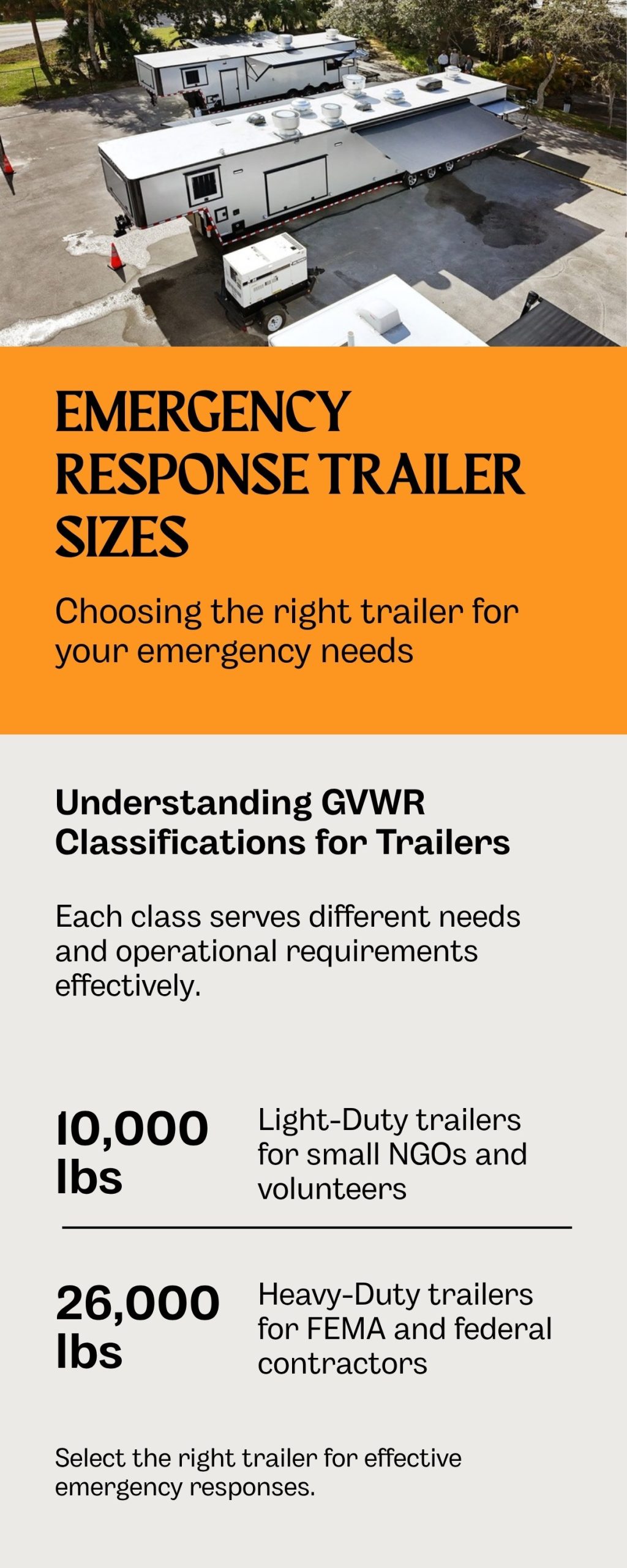
Spec decisions made at procurement determine operational capability for the life of the asset, often 15 to 20 years of active service. The single most important technical decision is gross vehicle weight rating (GVWR), because it drives every other decision: axle count, tow vehicle requirements, braking systems, and legal road limits.
What Is GVWR and Why Does It Matter?
GVWR is the maximum loaded weight of the trailer, including the unit itself, equipment, water, food, fuel, and personnel gear. The Federal Motor Carrier Safety Administration (FMCSA) sets commercial weight limits at 80,000 lbs gross combined weight for interstate highways, but the real constraint for most emergency agencies is their available tow vehicles (FHWA Size & Weight Regulations, FHWA). A light-duty pickup can handle up to 10,000-14,000 lbs with proper fifth-wheel or gooseneck hitch. A medium-duty commercial truck handles 26,000-33,000 lbs. Heavy-duty tandem-axle tractors handle the rest.
Generator and Power Systems
Off-grid operation is non-negotiable. A properly equipped emergency response trailer runs its own generator, typically a 15kW to 50kW diesel unit integrated into the frame, not a separate portable. Generator integration matters because it determines fuel logistics, noise abatement from the ops area, and run time between refueling. Look for auto-transfer switches and 50-amp shore power hookup capability so the unit can run on grid power when available and switch automatically during outages.
Satellite Communications and Comms Integration
Cell infrastructure fails first. Starlink and VSAT satellite systems now provide viable command communications in areas with zero cell coverage. Build these into the command post trailer from the beginning. Retrofit is expensive and rarely as reliable. Specify conduit runs, antenna mounting plates, and dedicated power circuits during the fabrication stage.
HVAC for Extreme Conditions
A mobile kitchen operating in a Florida summer generates significant internal heat from cooking equipment. A command post in a January Montana deployment needs reliable heat in sub-zero temperatures. Specify dedicated HVAC systems sized for the operational load, not just the square footage of the unit. Multi-zone systems allow kitchen and crew areas to run independently.
Slide-Outs and Awnings
Deployable slide-outs can increase interior square footage by 30-40% once the trailer is set. For command posts and kitchen units serving high-volume feeding operations, this matters. Awnings provide outdoor shaded work areas, protect generator access panels from rain, and create staging zones for supply delivery. Both are standard options on SDG builds.
In our experience building emergency response trailers for NGOs and law enforcement agencies, the single most overlooked spec at purchase is generator fuel capacity. Most operators underestimate daily consumption under full operational load, especially during summer deployments when HVAC is running continuously alongside kitchen or communications equipment.
The Guy Fieri Foundation Deployment: A Real-World Example
The Guy Fieri Foundation’s hurricane relief mission in Holmes County, Florida demonstrated what a properly specced emergency response kitchen trailer accomplishes in the field. SDG Trailers built the disaster relief equipment used in this operation: a custom mass-feeding kitchen trailer designed to serve high volumes of meals per day under full off-grid conditions.
Holmes County, FL sits in the Florida Panhandle, a region with some of the state’s most limited post-hurricane infrastructure. Roads flood. Power goes out for days. Cell service drops entirely. The SDG-built kitchen trailer ran on its own generator, carried onboard water, and was operational within hours of arrival. It fed first responders and displaced families while permanent infrastructure was still being assessed.
The operational profile for this type of deployment is demanding. First responders eat first. Then displaced residents. Then the next wave of mutual aid personnel arriving from out of state. A kitchen trailer serving this role needs commercial cooking capacity, NSF-certified surfaces, proper grease management, and a team that can operate it safely in field conditions. The equipment worked. That’s what purpose-built means.
This is the standard SDG builds to across all disaster relief trailer categories: not a concession trailer modified for field use, but a purpose-built disaster relief trailer engineered for the specific demands of emergency deployment.
What Does a Custom Emergency Response Trailer Build Look Like?
SDG Trailers has operated as a custom trailer manufacturer in Waycross, Georgia since 2001, with over two decades of documented production. Build timelines for emergency response trailers run 4-12 weeks depending on complexity, with standard mass-feeding kitchen builds typically completing in 6-8 weeks. SDG ships completed trailers to all 50 states and internationally.
The build process follows a defined sequence. Each phase has a clear purpose, and skipping any of them shows up in the finished unit.
Phase 1: Intake and Consultation (Week 1)
This is where operational requirements get translated into engineering parameters. What’s the mission? How many meals per shift, or how many personnel in the command post? What’s the primary tow vehicle? Where does the unit deploy: urban parking lots, rural fairgrounds, forward staging areas? The intake conversation determines GVWR, overall length, slide-out configuration, and power system sizing.
Phase 2: Design and Engineering (Weeks 1-2)
SDG produces detailed fabrication drawings before metal gets cut. This is when clients review the floor plan, equipment layout, door and window placement, and electrical/plumbing schematics. Changes at design stage cost nothing. Changes after fabrication begins are expensive and slow.
Phase 3: Fabrication (Weeks 2-8)
Frame welding, wall construction, roof framing, flooring, and exterior skin all happen in sequence. Electrical rough-in, plumbing rough-in, and HVAC installation occur concurrently with wall and roof completion. SDG’s fabrication is fully in-house at the Waycross facility. No subcontracted frame work, no outsourced systems integration.
Phase 4: Equipment Installation and Finishing (Weeks 6-10)
Commercial kitchen equipment, generator mounting, communications conduit, cabinetry, and exterior graphics go in during this phase. For command trailers, this is when workstations, AV systems, and communications hardware are installed and tested.
Phase 5: Quality Assurance and Load Testing (Weeks 10-12)
Before delivery, SDG tests electrical systems under full load, checks plumbing for leaks, verifies HVAC performance, and confirms all equipment operates to spec. Road-tow testing validates the hitch, brakes, and running lights before the unit leaves the facility. View the full range of custom trailers SDG fabricates for emergency and commercial applications.
What Does an Emergency Response Trailer Cost?
Cost ranges vary significantly by type, size, and equipment package. Ballpark figures help with budget planning, but every unit is quoted individually based on the final specification. There’s no standard emergency management trailer. That’s the nature of custom fabrication.
| Trailer Type | Typical Range | Key Cost Drivers |
|---|---|---|
| Light command/comms trailer | $25,000-$75,000 | Communications equipment, HVAC, generator |
| Mobile restroom trailer | $40,000-$90,000 | Stall count, ADA compliance, water capacity |
| Crew bunk trailer | $50,000-$120,000 | Berth count, HVAC zones, shower provisions |
| Mid-size kitchen trailer | $75,000-$175,000 | Equipment package, hood system, water capacity |
| Large mass-feeding kitchen | $150,000-$300,000+ | Length, equipment suite, generator size, slide-outs |
The primary cost drivers across all types are length (more trailer equals more material and equipment), axle count, generator size, custom equipment packages, and finishes. A base-spec trailer at any category’s low end will have fewer amenities and lower capacity than a fully loaded unit at the high end. Neither is wrong. It depends on your mission.
We’ve found that agencies and nonprofits who spend time on the intake consultation get trailers that perform exactly as expected in the field. The projects that come back for expensive modifications almost always skipped that conversation and ordered by general category rather than specific operational profile.
SDG offers financing options for qualified buyers, which matters for nonprofits and smaller agencies working within grant cycles or annual budget constraints. Talk to the team early about financing if procurement timing is a factor.
Frequently Asked Questions
What is the difference between an emergency response trailer and a disaster relief trailer?
The terms are often used interchangeably. Strictly speaking, “emergency response trailer” tends to cover the broader category including law enforcement command posts, fire rehab trailers, and EMS support units, all deployed within the first 72 hours of any incident. “Disaster relief trailer” typically refers to longer-term recovery assets like mass-feeding kitchens and crew housing used in post-disaster operations that stretch days to weeks. Many custom builds serve both roles depending on the incident. FEMA’s Emergency Support Functions categorize both under the broader “mobile support” framework (FEMA.gov, 2023).
Does an emergency response trailer need to meet FEMA standards?
FEMA does not publish a single mandatory trailer specification for non-federal buyers. However, FEMA’s National Response Framework and ESF-6 guidance establish operational standards for mass-care assets that effectively define what a capable trailer must do: off-grid power, adequate capacity, food safety compliance, and rapid deployability (FEMA.gov, 2023). State emergency management agencies may have additional requirements for trailers that will be integrated into state resource registries. Always check with your state emergency management agency before finalizing specs.
How long does it take to receive a custom emergency response trailer?
Standard build times at SDG Trailers run 4-12 weeks from signed order to delivery, depending on build complexity. A straightforward mobile restroom or light command trailer typically takes 4-6 weeks. A fully equipped mass-feeding kitchen with slide-outs, integrated generator, and custom equipment packages may take 10-12 weeks. SDG ships completed units to all 50 states and internationally using contracted heavy-equipment transport carriers.
What tow vehicle is required for an emergency response trailer?
Tow vehicle requirements depend entirely on GVWR. A light-duty emergency trailer under 10,000 lbs GVWR can be towed by a heavy-duty pickup with a proper receiver or gooseneck hitch. Medium-duty trailers (10,001-26,000 lbs) require a commercial truck with a Class 5 or higher rating. Heavy-duty trailers above 26,000 lbs require a semi-tractor. The FMCSA defines commercial vehicle weight classifications that determine licensing and weight limit requirements for interstate transport (FHWA Size & Weight Regulations, FHWA). Your SDG sales contact can specify exact tow requirements for your build.
Can an emergency response trailer be financed through SDG?
Yes. SDG Trailers offers financing options for qualified buyers, including nonprofits, government agencies, and private contractors. Financing timelines and terms vary. Contact the SDG team directly to discuss your procurement timeline and budget structure, especially if you’re working within a grant window or fiscal year deadline.
Citation Capsules
On FEMA deployment standards: FEMA’s National Response Framework (2023) identifies mobile support assets as essential under Emergency Support Function #6 (ESF-6), which governs mass-care, emergency assistance, temporary housing, and human services. Pre-positioned and rapidly deployable trailers are a core requirement for effective large-scale disaster response (FEMA.gov, 2023).
On emergency preparedness gaps: The FEMA National Preparedness Report consistently identifies mobile support capabilities as a top preparedness gap for state and local emergency management agencies, underscoring the growing demand for purpose-built emergency response trailers across government and nonprofit sectors (FEMA National Preparedness Report, 2024).
On NIMS command requirements: The National Incident Management System (NIMS) requires that command operations maintain unified command structures even across jurisdictions and agencies. Purpose-built mobile command trailers directly support NIMS compliance by providing a fixed, equipped incident command post that is independent of local infrastructure (DHS NIMS, 2023).
Get a Quote for Your Emergency Response Trailer
SDG Trailers has built disaster relief trailers and custom emergency response units for law enforcement agencies, nonprofits, and first responder organizations across the country since 2001. Every trailer is custom-fabricated at our Waycross, Georgia facility and shipped to all 50 states and internationally.
If you’re procuring for a government agency, qualifying for grant-funded purchases, or building out a nonprofit disaster relief fleet, the process starts with a single conversation. We’ll help you match the trailer type, spec, and build timeline to your operational requirements and budget.
“If It Ain’t Custom It Ain’t SDG Trailers.”
Contact SDG Trailers
- Phone: (800) 380-9743
- Email: sdgtrailers@gmail.com
- Address: 2255 Industrial Blvd, Waycross, GA 31503
- Web: sdgtrailers.com/contact/
Hours: Monday-Friday, 8:00 AM-7:00 PM | Pickup available by appointment
Author: SDG Trailers Team | SDG Trailers, Waycross, GA – custom trailer manufacturer since 2001.